In summary:
- Move beyond basic advice; true security involves understanding how modern burglars operate, from digital reconnaissance to keyless car theft.
- Prioritise security measures that provide a verified response (like monitored alarms) as these are most effective and valued by police.
- Be mindful that your online activity, especially social media check-ins, can be used by thieves and may even invalidate your insurance claim.
- Document everything immediately after a break-in to support your police report and ensure your insurance claim is valid.
- Protect against secondary threats like financial fraud and keyless car theft by using instant alerts and signal-blocking technology.
The feeling of violation after a burglary is profound. It’s not just about the items lost; it’s the shattering of your sense of safety in your own home. The immediate advice is always the same: change the locks, inform your insurer, and perhaps reinforce a window. While these steps are necessary, they are often a reactive plaster on a deep wound. They don’t address the lingering anxiety or the sophisticated methods used by today’s intruders, who are a world away from the opportunistic thieves of the past.
True peace of mind cannot be restored by simply adding a new deadbolt. It comes from understanding the modern burglar’s playbook and systematically dismantling their advantages. This involves a strategic shift from basic reinforcement to a multi-layered defence that accounts for digital reconnaissance, the limitations of standard alarms, and the specific clauses in your insurance policy that could render a claim void. It’s about making your home not just physically stronger, but strategically smarter and insurance-proof.
But what if the real key wasn’t just better hardware, but a better understanding of the threat? The most effective security measures are those that disrupt a burglar’s process, from their initial assessment of your property to their method of entry and escape. This guide will walk you through the practical, evidence-based steps to re-secure your home and, more importantly, your sense of control. We will explore how burglars think, which technologies genuinely deter them, and how to ensure your actions align with the requirements of your insurance policy, turning vulnerability back into confidence.
This article provides a structured approach to rebuilding your home’s security from the ground up. The following sections will detail everything from understanding burglars’ targeting methods to protecting yourself from advanced threats like keyless car theft, ensuring every step you take contributes to a safer home and a valid insurance claim.
Summary: A Strategic Approach to Post-Burglary Home Security
- Why Burglars Mark Properties Before Breaking In?
- How to Install a Ring Doorbell to Deter 80% of Opportunist Thieves?
- Monitored Alarm vs Bells-Only: Which One Actually Brings the Police?
- The Facebook Check-In Mistake That Voids Burglary Claims
- When to Report a Burglary to the Police to Ensure Claim Validity?
- How to Use Instant Notifications to Spot Fraud in Seconds?
- Why Thieves Can Steal Your Car in 60 Seconds Without the Key?
- Keyless Car Theft: Is Your Comprehensive Policy Enough?
Why Burglars Mark Properties Before Breaking In?
The classic image of a burglar is a stranger casing a neighbourhood from afar. The reality is often far more familiar. Research reveals that 54% of burglars live within 2 miles of the homes they target, allowing them to observe routines and identify vulnerabilities over time. However, the idea of thieves leaving chalk marks on a wall is largely a myth in the digital age. The modern form of « marking » a property is far more sophisticated and less visible: it’s called digital reconnaissance.
Instead of physical signs, burglars now turn to the vast, publicly available information on social media. They can identify potential targets, assess the value of their possessions, and crucially, determine when they are not at home, all without ever setting foot on the street. Announcing a holiday, showing off an expensive new purchase, or « checking in » at a location far from home are the new digital markers that signal an empty, high-value target. This online surveillance is efficient, low-risk, and provides burglars with a detailed profile of your life and assets.
Understanding this shift is the first step in fortifying your home. It’s not about looking for strange symbols on your fence; it’s about managing your digital footprint. The threat is no longer just a physical presence but a virtual one, gathering intelligence to plan the perfect time to strike. This makes online privacy an integral part of modern home security, as crucial as any lock or alarm system. Protecting your home starts with protecting your information.
How to Install a Ring Doorbell to Deter 80% of Opportunist Thieves?
Visible security measures are powerful psychological deterrents. A burglar’s primary goal is to get in and out quickly without being seen or identified. The mere presence of a video doorbell disrupts this plan at the most common point of entry: the front door. It signals that the property is monitored and that any approach will be recorded, creating a significant risk of identification. This is why a University of North Carolina study found that 60% of convicted burglars would choose another target if they discovered cameras.
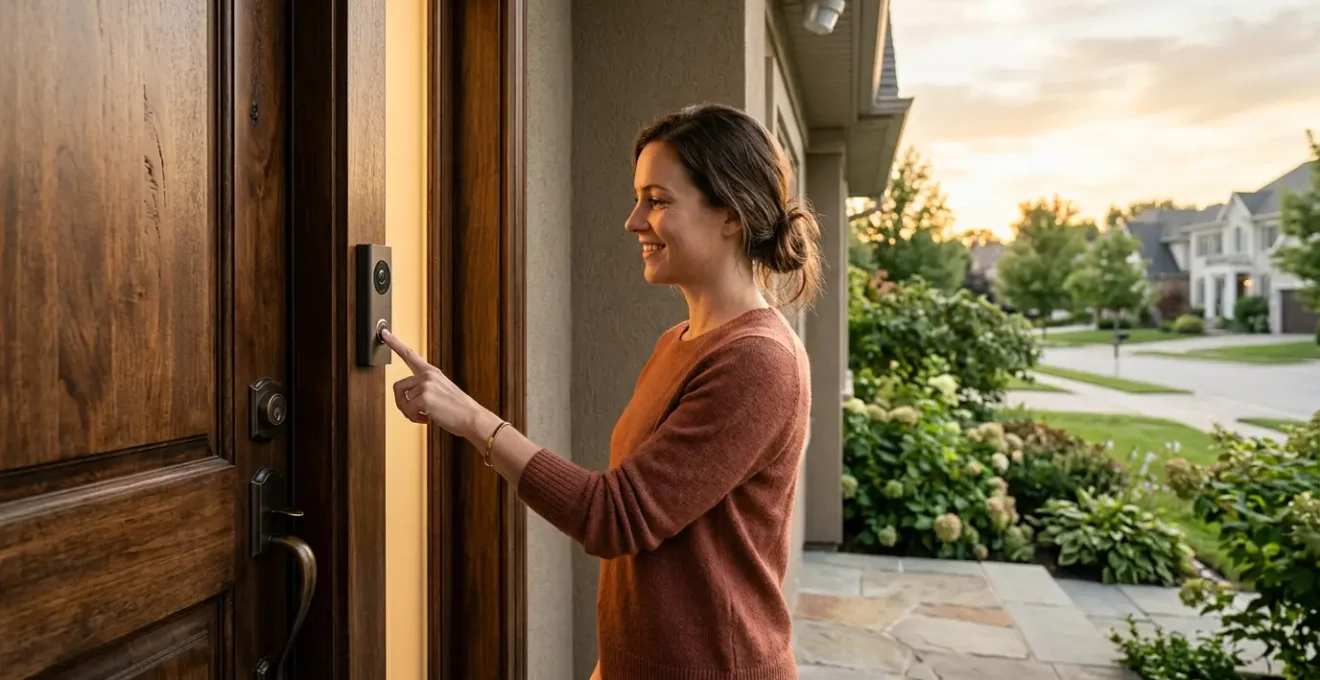
However, simple installation isn’t enough; strategic placement is key to maximising this deterrent effect. The camera must be positioned to achieve two goals: be obviously visible to anyone approaching, and capture a clear, identifiable image of their face. For this reason, the optimal placement is at eye level, approximately 48 to 55 inches (120-140 cm) from the ground. This ensures you capture faces, not just the tops of heads, and makes the device impossible to miss.

As the illustration demonstrates, this positioning provides a clear line of sight to the approach path, leaving no doubt in a potential intruder’s mind that they are being recorded. Furthermore, ensure your doorbell is connected to a reliable Wi-Fi network and that motion-activated notifications are enabled on your smartphone. This transforms the doorbell from a passive recording device into an active alert system, allowing you to respond in real-time, whether you’re at home or away. It’s this combination of visible deterrence and real-time monitoring that makes it so effective against opportunists.
Monitored Alarm vs Bells-Only: Which One Actually Brings the Police?
After a burglary, upgrading an alarm system is a top priority. However, a critical distinction exists between « bells-only » alarms and professionally monitored systems, and it directly impacts whether the police will respond. A bells-only system simply makes a loud noise, relying on neighbours to alert the authorities. In an urban environment, this is often ineffective due to « alarm fatigue, » where frequent false alarms cause people to ignore them. More importantly, police forces prioritise calls where a threat has been confirmed.
This is where a monitored alarm system proves its worth. When triggered, the signal is sent to a professional Alarm Receiving Centre (ARC). The ARC staff can then listen in, view camera feeds, or contact you to verify if the intrusion is real. Once verified, they escalate the incident directly to the police as a confirmed crime in progress, warranting an immediate, high-priority response. Unverified alarms from bells-only systems are treated as low priority, if they are responded to at all. Indeed, while the data is from the US, the principle holds true; a study revealed that nearly 80% of major cities have no guaranteed police coverage for unverified alarm calls, highlighting a global trend towards verified response protocols.
The differences extend beyond police response. Monitored systems offer a comprehensive security solution that insurers recognise and value. Here are the key advantages:
- Monitored systems offer guaranteed professional response with automatic dispatch to emergency services, regardless of your availability.
- Unmonitored systems rely entirely on you to initiate a response, which can lead to significant delays if you are unavailable or miss the notification.
- Monitored service providers typically include regular system check-ups and technical support as part of their package, ensuring the system is always operational.
- Many insurance providers offer lower premiums for homes with professionally monitored alarm systems, as they are proven to reduce loss.
- Verification protocols in monitored systems minimise the risk of costly false alarm fees that many local councils charge.
Choosing a monitored system is an investment in a guaranteed response. It removes the burden from you and your neighbours and ensures that when a real emergency occurs, you get the professional help you need without delay.
The Facebook Check-In Mistake That Voids Burglary Claims
In the aftermath of a burglary, the last thing anyone wants is a battle with their insurance company. Yet, a seemingly innocent social media post could be the very thing that leads to a denied claim. Insurers operate on the principle of « reasonable care, » which means homeowners are expected to take sensible precautions to protect their property. Publicly broadcasting your absence, such as posting holiday photos or « checking in » to an airport on Facebook, can be interpreted by an insurer as a failure to take such care.
You are, in effect, advertising that your home is empty and vulnerable. While it may seem unfair, this can give an insurer grounds to argue you have contributed to the loss. This isn’t a rare occurrence; according to insurance company Aviva, 36% of insurance claims are affected by social media findings, demonstrating that investigators actively look for this information. As security experts at Barry Bros Security highlight, this is a serious pitfall for policyholders.
Give too much information away, such as sharing your holiday plans on social media, and your insurer may not honour a claim, because you have in effect advertised your property as being empty.
– Barry Bros Security, Five Things That Can Invalidate a Burglary Insurance Claim
To avoid this, the rule is simple: post after you return. Share your holiday memories once you are safely back home. In the eyes of your insurer, securing your home also means securing your information. This includes ensuring your privacy settings are robust and you aren’t publicly sharing details about your movements or high-value possessions. Documenting that you have taken reasonable care, such as having locked all doors and set your alarm, is crucial.
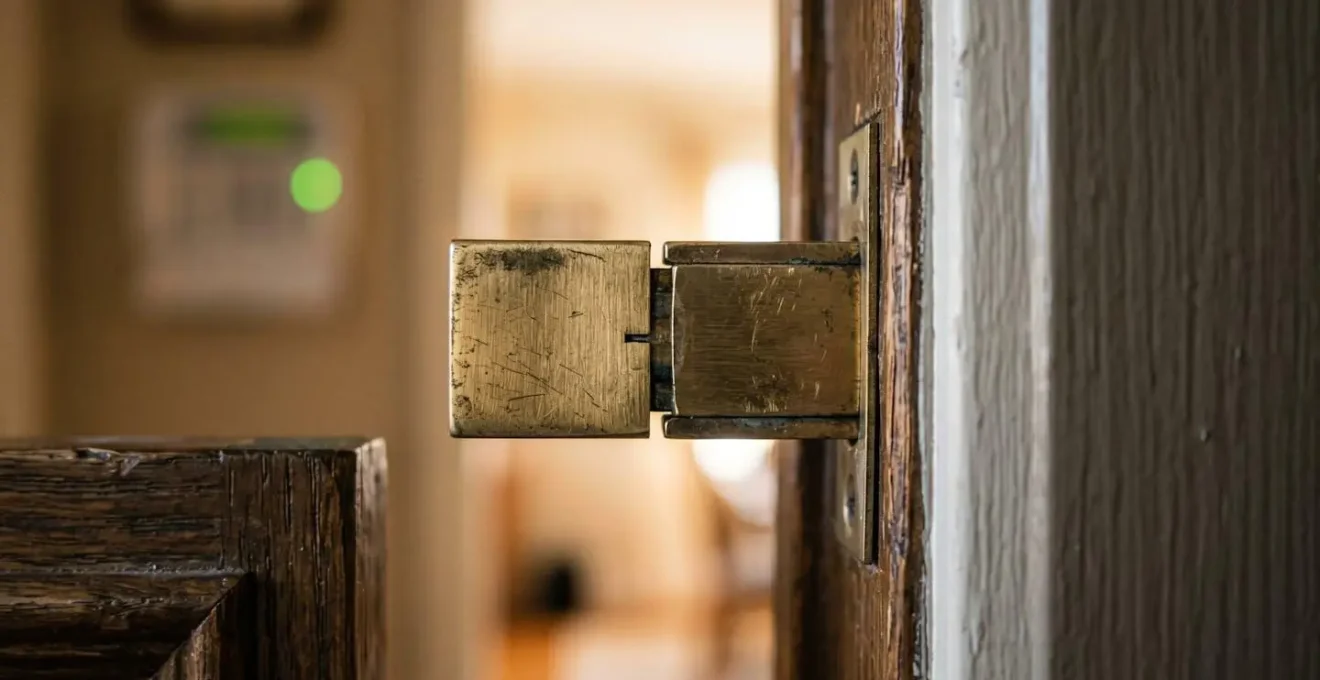
The image of a securely locked door and an activated alarm is what your insurer expects. Contradicting that with a public announcement of your absence creates a conflict that can cost you dearly. Your digital silence is a vital part of your home’s security and the validity of your insurance policy.
When to Report a Burglary to the Police to Ensure Claim Validity?
Discovering your home has been broken into is a disorienting and distressing experience. In that moment, your actions are critical, not only for your safety but also for the success of any future insurance claim. The single most important first step is to call the police immediately. Do not wait. Do not go inside to assess the damage first. Your insurer will require a crime reference number to process your claim, and this can only be issued after a police report is filed. The time of your call creates an official timestamp for the incident.
Preserving the scene is the next priority. Every surface could hold vital evidence, such as fingerprints, that could help police identify the culprit. FBI data shows that only 13.5% of burglaries are cleared by arrest, a sobering statistic that underscores the importance of not contaminating the crime scene. Touching doors, light switches, or disturbed items could destroy the very evidence needed to solve the case. Once the police have given you permission, you should thoroughly document everything with photographs, paying close attention to points of entry, any damage, and areas where items are missing.
Navigating the immediate aftermath requires a clear head and a methodical approach. The following checklist outlines the essential steps to take to ensure your safety and protect the integrity of your insurance claim.
Action plan: Immediate steps after discovering a burglary
- Do not enter: If you suspect the intruder may still be inside, back out immediately and find a safe place like a neighbour’s house or your car.
- Call the police: Use your mobile phone or a neighbour’s phone to call 999. This creates the critical timestamp for your insurance claim and initiates the response.
- Preserve evidence: Avoid touching anything inside the property until the police have conducted their forensic examination to preserve potential fingerprint or DNA evidence.
- Document the scene: Once police give you permission, take photos and videos of all points of entry, property damage, and the general state of the rooms.
- Notify key parties: After the police, inform your bank to freeze cards if a wallet was stolen, and notify your monitored alarm company about the incident to check for any theft protection guarantees.
How to Use Instant Notifications to Spot Fraud in Seconds?
The violation of a burglary often extends beyond your home and into your finances. Stolen wallets, bank cards, or even mail containing personal information can be used by criminals to commit identity theft or fraudulent transactions within minutes. In this scenario, speed is your greatest defence. Setting up instant transaction alerts on all your bank and credit card accounts is the most effective way to create a digital tripwire and spot fraudulent activity the second it happens.
Don’t settle for default alert settings. After notifying the police of the break-in, your next call should be to your financial institutions, but your most powerful tool is your banking app. Most apps allow you to customise alerts with a high degree of precision. By setting the threshold to the lowest possible amount (e.g., any transaction over £1), you ensure that no unauthorised purchase, no matter how small, goes unnoticed. Thieves often test a stolen card with a small purchase before making a larger one; this strategy allows you to shut them down at the first attempt.
A comprehensive financial alert system is a critical part of your post-burglary recovery plan. It provides an immediate, actionable defence against secondary financial crimes. Follow these steps to configure your alerts for maximum protection:
- Immediately after calling the police, log into your banking apps and activate all bank and credit card transaction alerts to catch fraud from a stolen wallet or mail.
- Set custom alert thresholds to the lowest possible amount, such as any transaction over £1, to create a ‘digital tripwire’ for any unauthorised use.
- Enable specific alerts for any international transactions or purchases made outside your normal geographic area, as these are common red flags for fraud.
- Contact your monitored alarm company to check for any theft protection guarantee policies that may offer to cover your insurance deductible, reducing your out-of-pocket costs.
- Create a 3-step emergency response plan for when an alert is received: immediately freeze all accounts via your app, call your bank’s fraud department, and document the incident for your main burglary insurance claim.
Why Thieves Can Steal Your Car in 60 Seconds Without the Key?
One of the most unsettling modern theft methods is the keyless car robbery, often happening while you are at home and your car is parked on the drive. This is not a case of brute force; it’s a high-tech crime known as a « relay attack. » It exploits the very radio signal that makes keyless entry so convenient, and it allows thieves to unlock and start your car in under a minute without ever having the key. The speed of this crime is consistent with the efficiency of modern burglars, as FBI research indicates that most home burglaries take only 8 to 10 minutes on average.
The technique is alarmingly simple and requires two criminals working in tandem with inexpensive signal-amplifying devices. One thief stands near your front door or a ground-floor window, using a device to capture the weak signal constantly being emitted by your key fob from inside your house. This signal is then relayed to an accomplice standing by your car, whose device mimics your key, tricking the car into unlocking its doors and enabling the ignition. The entire process is silent, leaves no signs of forced entry, and is over in seconds.
Case Study: The Relay Attack Method
Modern burglars frequently employ relay attack technology to steal keyless-entry vehicles. One thief stands near the home’s front door with a signal amplifier to capture the key fob’s radio signal from inside the house. Simultaneously, an accomplice positioned by the car receives the amplified signal via their own device. This allows them to unlock and start the vehicle within 60 seconds without ever touching the actual key. To counter this, security experts recommend storing key fobs in Faraday pouches or metal containers to block the signal, and keeping them as far as possible from exterior walls and entry points to prevent signal interception.
Defeating this threat does not require expensive vehicle modifications. The solution is simple and cheap: break the signal relay. Storing your keys in a signal-blocking Faraday pouch or a simple metal tin is the most effective method. This creates a barrier that the thieves’ amplifiers cannot penetrate, rendering their equipment useless and keeping your car exactly where you left it.
Key takeaways
- The modern burglar’s primary tool is no longer a crowbar but a smartphone, using social media for ‘digital reconnaissance’ to identify empty, high-value homes.
- A ‘bells-only’ alarm is largely ineffective; only professionally monitored systems with verified response protocols guarantee a priority police dispatch.
- Keyless car theft using relay attacks is a major, silent threat that can be neutralised by storing car keys in a simple signal-blocking Faraday pouch.
Keyless Car Theft: Is Your Comprehensive Policy Enough?
Having your car stolen from your driveway is a major loss, but the subsequent insurance claim can lead to another shock. Many comprehensive car insurance policies contain clauses that can complicate claims for keyless thefts. The core issue lies with the concept of « forced entry. » Analysis of claim denials shows that insurers generally require evidence of forced entry to honour a theft claim. In a relay attack, there is no broken window or forced lock; the car is tricked into opening itself. This lack of physical evidence can become a contentious point with your insurer.
Because the car was stolen without any visible damage, the burden of proof falls on you to demonstrate that you took reasonable care to secure your vehicle and its keys. You must prove that the theft was the result of a sophisticated criminal act and not negligence, such as leaving the key fob in an obvious or unsecured location. Without this proof, an insurer might argue that the circumstances of the theft are not covered, leaving you with a significant financial loss despite having a comprehensive policy.
To successfully claim for a keyless car theft, you must proactively build a body of evidence. The police report is just the starting point. Your goal is to create a clear narrative, supported by documentation, that shows the theft occurred despite your responsible actions. The following evidence is crucial for your claim:
- File a police report immediately and obtain a crime reference number. This is the foundational document for any insurance claim.
- Gather any available CCTV footage or video doorbell recordings that show suspects near your property or vehicle, even if their actions seem inconclusive.
- Document any digital logs from your monitored home alarm system, which may provide time-stamped data of activity around your home at the time of the incident.
- Provide clear proof of ownership, including the vehicle’s V5C registration document, purchase receipts, and up-to-date insurance documents.
- Demonstrate reasonable care by explaining and, if possible, showing where the keys were stored securely inside your locked home, far from entry points.
This meticulous preparation transforms your claim from a simple report of loss into a well-documented case, significantly improving your chances of a successful outcome and proving that your comprehensive policy should indeed be enough.
By implementing these strategic layers of security, you move from a position of reaction to one of proactive control. The next logical step is to review your current setup against these modern threats and create a clear, prioritised plan for upgrading your physical, digital, and financial defences.