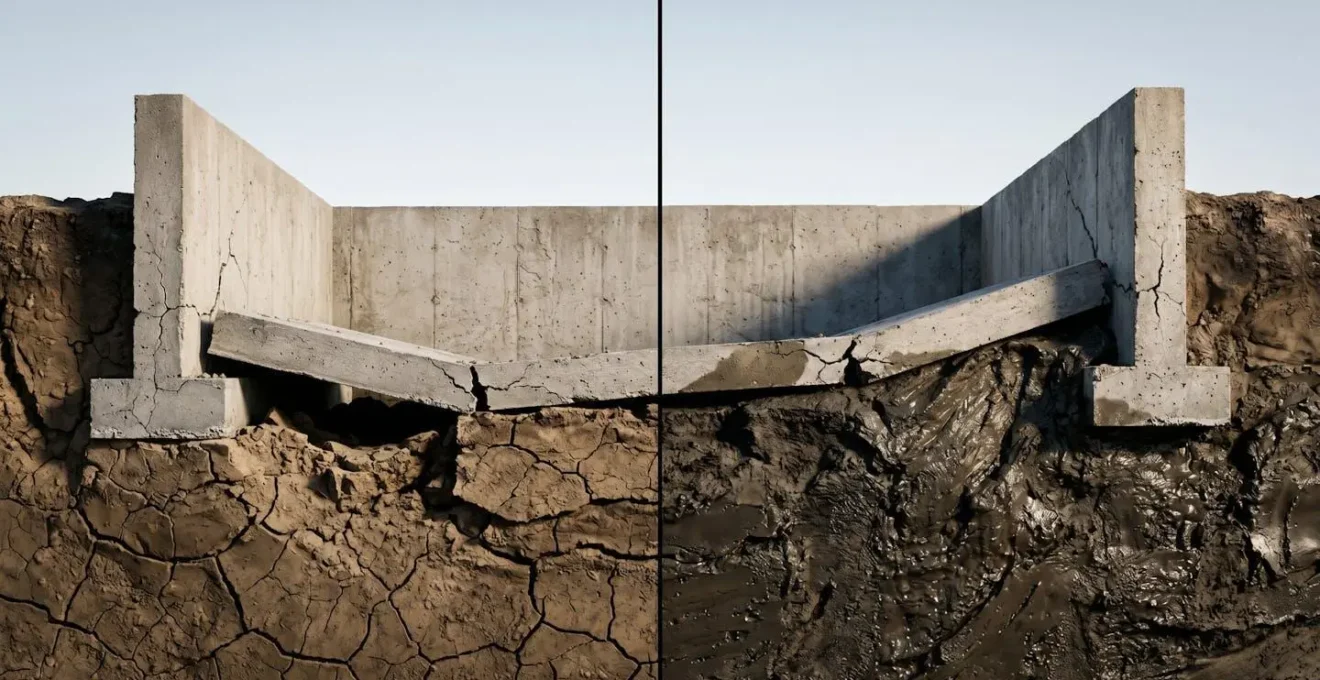
True protection from subsidence damage goes beyond spotting cracks; it requires mastering the engineering principles and hidden insurance clauses that determine financial outcomes.
- Subsidence is primarily a soil mechanics problem, where clay soil shrinkage during droughts causes foundations to fail, a risk exacerbated by high water-demand trees.
- Insurers operate on an “Evidentiary Threshold”; a detailed monitoring log is non-negotiable before making a claim, which can take 1-2 years to resolve.
Recommendation: Proactively calculate your home’s true rebuild cost, including demolition and professional fees, as underinsurance can void your claim through the ‘Average Clause’, leaving you with catastrophic personal costs.
For homeowners in London and the South East, the long, dry summers have brought a creeping anxiety that has little to do with the heat itself. It’s the appearance of fine, spidery cracks along walls, the slight sticking of a door that once swung freely. These are the tell-tale signs that your property, likely sitting on the region’s prevalent clay soil, might be experiencing subsidence. The common advice is to watch for cracks wider than a 10p coin and call your insurer. While not entirely wrong, this approach is dangerously simplistic and ignores the complex interplay between soil mechanics, arboriculture, and insurance policy fine print.
The reality is that subsidence is not just a building problem; it’s a systems problem. The ground beneath your home is in a delicate dance with the climate, and a mature willow tree in your garden can act as a powerful, disruptive force. Understanding this structural equilibrium is the first step. But the true battle is often not with the shifting earth, but with the insurance process that follows. Insurers have established protocols, clauses, and repair hierarchies designed to manage their financial exposure. Simply reporting a crack without robust evidence is like going into a negotiation unprepared.
But what if the key to navigating this risk wasn’t just about reacting to damage, but about proactively understanding the system? This guide moves beyond the platitudes. As a structural engineer, my goal is to equip you with a deeper understanding of the ‘why’ behind the cracks and the ‘how’ of the insurance claim process. We will explore the mechanics of clay soil, the critical importance of monitoring, the pros and cons of modern repair techniques, and the hidden financial traps—like the devastating ‘Average Clause’—that can turn a manageable repair into a financial catastrophe. This is your blueprint for protecting your most valuable asset not just from the ground down, but from the policy up.
This article provides a comprehensive roadmap, from identifying the root causes of foundation movement to ensuring your insurance provides the protection you expect. The following sections break down each critical stage, offering technical insight and practical, actionable advice.
Contents: Subsidence vs Heave: Which Foundation Risk Is Covered by Insurance?
- Why Dry Summers Cause Cracks in Properties Built on Clay?
- How to Monitor Wall Cracks Before Calling the Insurer?
- Mass Concrete vs Resin Injection: Which Underpinning Method Is Less Disruptive?
- The Willow Tree Risk That Can Devalue Your Home by 20%
- When to Notify Your Insurer About Cracks: Immediately or After Monitoring?
- Why Undervaluing Your Rebuild Cost Cuts Your Claim by 50%?
- The EPC “C” Rating Rule That Could Make Your Rental Illegal
- Buildings Insurance: How to Calculate Rebuild Cost Correctly?
Why Dry Summers Cause Cracks in Properties Built on Clay?
The relationship between London’s clay soil and its architecture is a delicate one, governed by water. Clay soils, like the expansive London Clay Formation, behave like a sponge. During wet periods, they absorb water and swell; during prolonged dry spells, they lose moisture and shrink in volume. This process, known as desiccation, is the primary driver of subsidence in the South East. When the soil beneath your home’s foundations shrinks, it withdraws support, causing parts of the building to drop. This differential movement creates stress in the building’s superstructure, which is released in the form of characteristic diagonal cracks.
This isn’t a minor issue; the economic impact is staggering. The cumulative cost of shrink-swell subsidence in the UK has been estimated to be over £3 billion over the past decade, according to the British Geological Survey. The problem is most acute for properties with shallow foundations, common in Victorian and Edwardian housing stock, as they sit directly within the zone of seasonal moisture change.
The illustration above provides a powerful macro view of this process. You can see the deep fissures that form as the clay loses moisture. The visible root fibres highlight the role of vegetation, which dramatically accelerates water extraction from the soil. The building itself is not failing; rather, the ground it relies on for structural equilibrium is being removed from beneath it. Understanding this fundamental mechanism is the first step in diagnosing the problem correctly and not mistaking it for normal settlement.
How to Monitor Wall Cracks Before Calling the Insurer?
When you discover a crack, the instinctive reaction is often to panic and immediately call the insurance company. This can be a strategic mistake. Insurers operate on what can be termed an ‘Evidentiary Threshold’. To approve a subsidence claim, they require definitive proof that the crack is A) structural in nature and B) actively moving or progressing. Simply reporting a static hairline crack will likely result in a swift rejection and a note on your property’s file, potentially complicating future insurance. Your first task is not to report, but to become a meticulous evidence-gatherer.
The goal is to build a comprehensive monitoring log over several weeks or months. This log serves as your primary evidence, demonstrating to the insurer that the damage is ongoing and not merely historic or cosmetic settlement. By presenting a detailed, dated record of the crack’s progression, you move from a position of anecdotal concern to one of factual certainty, significantly strengthening your position when you do eventually make contact.
Case Study: Width Classification for Subsidence Cracks
Insurance industry guidelines distinguish between cosmetic and structural cracks based on width. Hairline cracks under 2mm are typically harmless and can be filled. Cracks between 2-5mm warrant monitoring as they may indicate minor movement. However, cracks wider than 15mm are classified as severe and point to significant foundation issues requiring immediate assessment. The orientation is also critical; diagonal or stepped cracks that are wider at the top are a classic signature of subsidence, as opposed to the uniform width of a simple settlement crack. Your monitoring log should precisely document these characteristics over time.
Action Plan: Building a Professional Crack Monitoring Log
- Measure the width of the crack using a ruler or crack gauge and record the exact measurement in millimeters.
- Mark the point where the crack ends with a pencil and date the marking to track if it is lengthening.
- Take dated photographs from the same position and distance each time you monitor (weekly for active cracks, monthly for stable ones).
- Document the weather conditions at the time of each observation (e.g., “after two weeks of dry weather,” “following heavy rain”).
- Note the precise location of each crack (e.g., “internal, first-floor front bedroom, above window frame”).
- Record whether the crack is widening, lengthening, or remaining stable over the observation period.
- Compile all photos, measurements, and notes into a chronological file to present to your insurer, demonstrating due diligence.
Mass Concrete vs Resin Injection: Which Underpinning Method Is Less Disruptive?
Once subsidence is confirmed and the cause addressed (e.g., by managing a nearby tree), the focus shifts to repair. The insurer will commission a structural solution, and understanding the options is crucial. The two primary methods are traditional mass concrete underpinning and modern resin injection. From an engineering perspective, they achieve the same goal—stabilizing the foundation—but their impact on your life and property are vastly different. This choice often falls into a Repair Hierarchy, where insurers may prefer the lowest-cost option that meets the technical requirement, which may not align with your preference for minimal disruption.
Traditional underpinning is the “heavy-duty” solution. It involves excavating sections beneath your existing foundations and pouring concrete to create new, deeper footings that rest on more stable ground. It’s an incredibly robust and time-tested method, but it is also highly disruptive, time-consuming, and destructive to landscaping, patios, and driveways. Resin injection, by contrast, is a far more surgical approach. Small holes are drilled through the foundation, and a specialist geopolymer resin is injected. This resin expands, compacting the weak ground and raising the foundation back towards its original level. As leading experts at Mainmark Ground Engineering note, “Resin injection underpinning is typically more cost-effective compared to traditional methods, and it can often be completed within a day, making it a popular choice for homeowners looking for a quick and efficient solution.”
The choice between them depends on the severity of the movement and soil conditions. For minor to moderate, targeted settlement, resin injection is often sufficient. For severe, widespread issues, mass concrete may be unavoidable. The following table breaks down the key differences to help you understand the implications of each method.
| Factor | Mass Concrete Underpinning | Resin Injection Underpinning |
|---|---|---|
| Duration of Work | 4-6 weeks including excavation, curing, and site restoration | 1-2 days for typical residential projects |
| Disruption Level | High: Requires excavation, heavy machinery, may need to vacate property | Minimal: No excavation, completed through small 16mm holes |
| Garden/Landscaping Impact | Significant: Excavation around perimeter damages landscaping, driveways, patios | Negligible: Small injection points, minimal surface disturbance |
| Cost Range (Typical) | £150-£300 per linear metre; total projects £15,000-£35,000+ | £2-£20 per square foot; total projects £4,000-£15,000+ |
| Guarantee/Longevity | 100+ year proven track record, traditional reliability | 30+ year global track record when performed by experts |
| Future Insurability | Must be declared; may affect premiums and future saleability | Must be declared; generally viewed more favorably as less invasive |
| Best Suited For | Severe structural issues, widespread settlement, deep foundation requirements | Minor to moderate settlement, quick stabilization, targeted repairs |
The Willow Tree Risk That Can Devalue Your Home by 20%
While dry weather creates the conditions for subsidence, the most common trigger, especially in leafy suburbs, is vegetation. Certain tree species are notoriously thirsty, and their root systems can extend vast distances in search of water. In a drought, a large tree can draw tens of thousands of litres from the soil, causing targeted and severe clay shrinkage in its ‘zone of influence’. This is why a crack might appear suddenly on only one side of a house—the side closest to a large tree.
The most high-risk species are those with high water demand, including poplar, oak, elm, and particularly willow. The presence of a mature willow tree close to a property can be a major red flag for surveyors and mortgage lenders, potentially reducing a property’s value by up to 20% due to the perceived subsidence risk. The problem is so well-documented that clear guidance exists on safe planting distances, which are often ignored in older properties.
Case Study: Safe Planting Distances from Biddle’s Research
Pioneering research by Biddle, which analyzed thousands of subsidence cases, established critical safe planting distances now incorporated into NHBC guidelines. For high water-demand species like oak and willow, 75% of subsidence damage occurred when trees were less than 12-15 metres from the building. For moderate-demand trees like sycamore and plane, the critical distance was 8-10 metres. For lower-demand trees like birch, it was 5-8 metres. These distances are based on the mature height of the tree and are especially critical for properties with shallow foundations built before the 1950s.
Managing this risk can involve crown reduction (to reduce the tree’s water demand) or, in severe cases, removal—though this must be done with extreme care, as sudden rehydration of the soil can cause ‘heave’, the opposite of subsidence, which can be equally damaging. If the tree is protected by a Tree Preservation Order (TPO), the situation becomes even more complex, requiring expert negotiation with the local authority.
When to Notify Your Insurer About Cracks: Immediately or After Monitoring?
The decision of when to formally notify your insurer is a critical strategic choice. As established, initiating a claim without sufficient evidence is unwise. Once you have a comprehensive monitoring log demonstrating active movement over several months, the time to act has come. However, be prepared for a long and potentially adversarial process. The moment you file a claim, your insurer appoints a ‘loss adjuster’—an expert whose role is to investigate the claim on behalf of the insurer and, ultimately, protect their financial interests. This creates an immediate imbalance of power.
You are a homeowner; they are a team of professionals who handle such claims every day. They may argue the damage is pre-existing, not covered by your policy, or propose the cheapest possible repair rather than the most robust one. This is why many homeowners choose to level the playing field by appointing their own independent ‘loss assessor’ or surveyor. This expert works for you, interpreting the technical data, challenging the loss adjuster’s findings, and arguing for the necessary repairs to ensure the long-term stability of your home. The cost for this professional is often covered by the insurance policy itself, but you must check the fine print.
The Expert’s Role in a High-Stakes Claim
In a subsidence claim, the insurer’s loss adjuster may push for a low-cost resin injection when a structural engineer appointed by your loss assessor determines that more substantial underpinning is required for permanent stabilization. The loss assessor’s team provides the technical counter-argument, backed by engineering reports, to ensure the repairs are adequate, not just expedient. This is particularly crucial in complex cases where repair costs run into tens of thousands of pounds and insurers are incentivized to minimize payouts.
Patience is paramount. Even with a straightforward claim, the process is lengthy. It involves an initial assessment, a period of monitoring by the insurer’s engineers (which can be up to 12 months to track a full seasonal cycle), tendering for works, and finally the repair itself. According to major insurer Aviva, most subsidence claims take between one to two years to fully resolve from notification to completion of repairs. Understanding this timeline from the outset helps manage expectations and stress.
Why Undervaluing Your Rebuild Cost Cuts Your Claim by 50%?
Perhaps the single greatest financial risk a homeowner faces in a major claim is not the subsidence itself, but being underinsured. Many people mistakenly believe their ‘sum insured’ should reflect the market value of their home. This is incorrect. The sum insured must cover the total cost of rebuilding the property from scratch, including demolition, site clearance, professional fees, and VAT. If this figure is too low, insurers apply a penalty known as the ‘Average Clause’, and its effect is devastating.
The Average Clause works on a principle of proportionality. If your home’s true rebuild cost is £500,000, but you only insured it for £250,000, you are 50% underinsured. The insurer will therefore only pay 50% of any claim you make, regardless of its size. As insurance industry experts warn in an analysis of the Average Clause’s application in subsidence claims, “If you are 50% underinsured, the insurer will only pay 50% of your claim, not just for the cracked walls, but also for the £50,000 underpinning bill.” This creates a powerful and negative financial leverage against the policyholder.
Worked Example: The Average Clause in Action
Imagine your home’s correct rebuild cost is £400,000, but you’re insured for £200,000 (50% underinsured). You suffer subsidence requiring £60,000 of repairs. The insurer will apply the Average Clause and pay only 50% of the claim: £30,000. You are also liable for your policy excess (typically £1,000 for subsidence). Your total out-of-pocket cost is £31,000, leaving you with a massive shortfall for essential structural repairs. This punitive clause is standard in most home insurance policies and is the homeowner’s responsibility to avoid by ensuring their sum insured is accurate.
The consequences are catastrophic. A major subsidence event can easily cost £50,000 to £100,000 to rectify. Being underinsured by 30% could leave you with a personal bill of £15,000 to £30,000 on top of your excess. It is imperative to use professional resources, such as the RICS rebuild cost calculator, to get an accurate figure and update it regularly, rather than relying on guesswork or market value.
The EPC “C” Rating Rule That Could Make Your Rental Illegal
For landlords, the financial consequences of subsidence extend beyond repair costs into the realm of regulatory compliance. Structural damage from foundation movement creates a direct pathway for energy loss. Cracks, distorted window frames, and gaps at the wall-floor junction act as thermal bridges and sources of uncontrolled air infiltration. This severely compromises a property’s thermal performance, which is measured by its Energy Performance Certificate (EPC) rating.
A property that previously held a compliant EPC rating can see its score plummet by one or even two bands after suffering subsidence. This has dire implications for landlords in the UK, where legislation requires private rented properties to achieve a minimum EPC rating of ‘E’, with proposals to raise this to ‘C’ for new tenancies. A property that drops from a ‘C’ to a ‘D’ or ‘E’ due to subsidence damage can become legally unrentable until the necessary upgrades are made. The scale of the subsidence problem is growing, with data from the Association of British Insurers showing that domestic subsidence payouts reached £66 million in Q3 2023, a 61% increase year-on-year, reflecting the impact of recent dry summers.
Case Study: The Double Financial Hit of Subsidence for Landlords
A landlord owns a Victorian terrace in London with a ‘C’ EPC rating. Subsidence causes significant cracking around windows and doors, and an updated EPC assessment downgrades the property to a ‘D’. The property is now illegal to let to a new tenant. The landlord faces a double financial burden: first, the cost of the structural repairs (e.g., £25,000 for resin injection), which may only be partially covered if they are underinsured. Second, the cost of mandatory energy efficiency works (e.g., £15,000 for new double-glazing and insulation) required to restore the ‘C’ rating. A savvy landlord would integrate these energy upgrades into the post-subsidence reinstatement works, achieving both goals more cost-effectively.
This creates a significant hidden liability. The insurance policy will cover the structural repair (‘indemnifying’ you to your previous state), but it will not typically pay for the energy efficiency upgrades needed to meet a higher legal standard. Landlords must therefore see subsidence repair not just as a structural necessity but as a critical opportunity to carry out thermal upgrades simultaneously to protect their rental income.
Key Takeaways
- Subsidence is a soil mechanics issue caused by clay shrinkage, accelerated by trees, and requires robust monitoring evidence before contacting an insurer.
- The ‘Average Clause’ is a major financial risk; insuring your property for its full rebuild cost, not market value, is non-negotiable to avoid claim reductions.
- Repair methods vary drastically in disruption and cost; resin injection is less invasive for moderate cases, while mass concrete is for severe issues.
Buildings Insurance: How to Calculate Rebuild Cost Correctly?
Ensuring your property is insured for the correct amount is the single most important step you can take to protect yourself financially. As we’ve seen, getting this wrong exposes you to the ‘Average Clause’. The key is to banish ‘market value’ from your thinking and focus exclusively on the total rebuild cost. This is a far more complex calculation that must account for a host of expenses that arise in a “total loss” scenario, such as a catastrophic fire or subsidence requiring complete demolition.
GoCompare Insurance Experts state that, “Properties with a history of subsidence are difficult to insure and you might end up paying higher premiums with a specialist insurer.” This makes getting the cover right from the start even more critical. The rebuild cost isn’t just the price of bricks and mortar; it must include demolition of the existing structure, site clearance, professional fees for architects and structural engineers (which can be 10-15% of the build cost), planning and building regulation compliance costs, and VAT at 20% on all labour and materials. For period properties, the cost of sourcing specialist materials must also be factored in.
While online calculators from the RICS (Royal Institution of Chartered Surveyors) provide a good starting point, for complex or high-value properties, a formal valuation from a qualified surveyor is the only way to be certain. The following checklist outlines the hidden costs that are frequently overlooked but must be included in your final ‘sum insured’ figure.
- Demolition and site clearance: Costs to safely remove the damaged structure and prepare the site for rebuilding.
- Professional fees: Fees for architects, structural engineers, surveyors, and project managers.
- Temporary accommodation: The cost of renting a comparable property while yours is uninhabitable, which for a major subsidence claim can be 12-24 months.
- Furniture and belongings storage: Costs for securely storing your contents during the rebuild.
- Building regulations compliance: The cost of upgrading the new build to meet current standards for insulation, access, etc., which may be higher than the original build.
- VAT: 20% tax on all labour and materials, which is not recoverable for private homeowners.
- Specialist materials: The premium cost for reclaimed bricks, lime mortar, or other heritage-compliant materials for period properties.
- Upgraded foundations: If rebuilding after subsidence, the new foundations must be designed to modern standards to prevent recurrence, adding significant cost.
- Access and scaffolding: Costs for site access, hoarding, and full scaffolding.
- Contingency fund: An essential buffer of 10-15% of the total cost to cover unforeseen complications, which are common in complex rebuilds.
By understanding these engineering principles and insurance mechanisms, you can shift from being a passive victim of circumstance to an informed and proactive manager of your property’s long-term health and financial security. The next logical step is to review your current policy documents and use a professional service to verify your rebuild cost is accurate today.