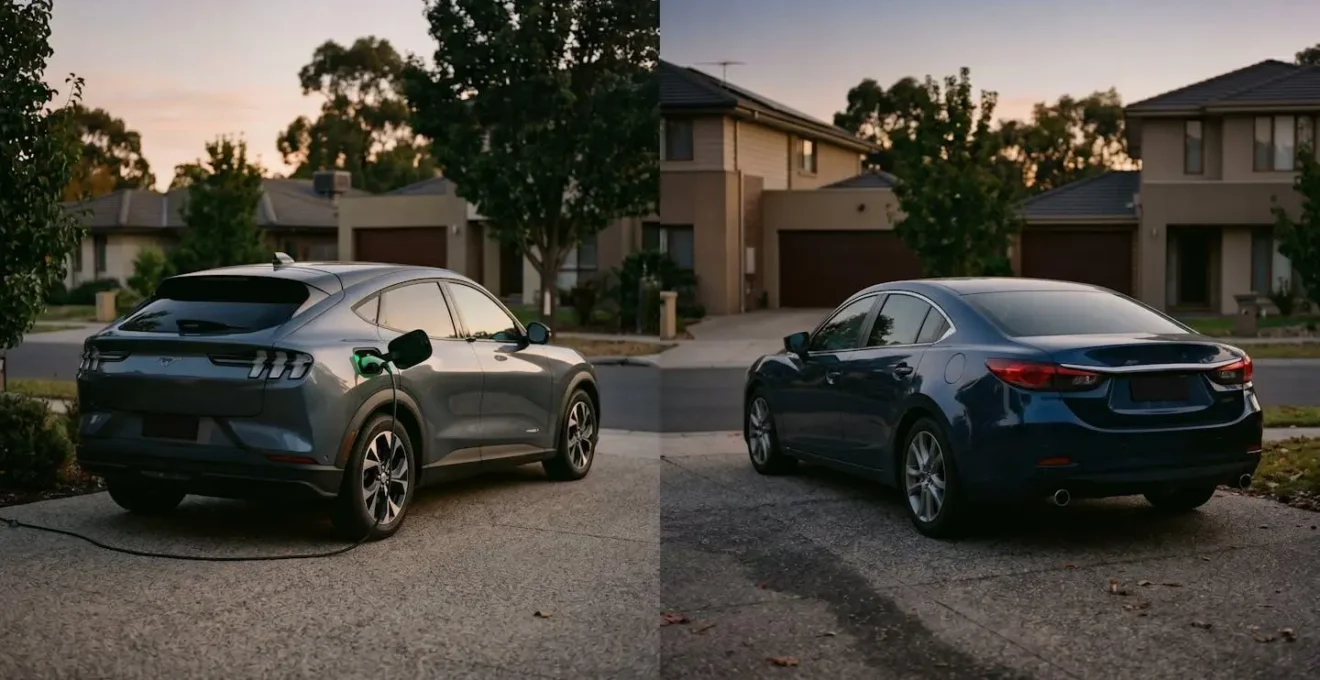
The high cost of EV insurance isn’t just about the purchase price; it’s driven by the vehicle’s nature as an integrated electronic ecosystem where minor damage leads to complex and expensive system-wide repairs.
- A simple bumper repair can trigger a « calibration cascade, » requiring costly recalibration of essential safety sensors.
- Proprietary components, especially for brands like Tesla, lack cheaper aftermarket alternatives, forcing the use of expensive Original Equipment Manufacturer (OEM) parts.
Recommendation: Scrutinise potential policies for specific EV cover, including sensor calibration, OEM parts, and battery leasing terms, as a standard policy may leave you significantly underinsured.
If you’ve recently switched to an electric vehicle (EV), you’re likely enjoying the lower running costs and quieter journeys. But if you’ve also just received your first insurance quote, you may have been met with a significant shock. It’s a common frustration for new EV owners in the UK: why does insuring a supposedly cheaper-to-run electric car often cost substantially more than its petrol equivalent? The typical answers point to the high initial purchase price and the daunting cost of the battery pack.
While these factors are true, they are only a small part of a much more complex picture. They are the visible symptoms, not the root cause. Focusing solely on the battery cost is like judging an iceberg by its tip. The reality is that insuring an EV is more expensive because it is not simply a car with a different engine; it’s a fundamentally different piece of technology. It is a sophisticated, rolling computer network.
The real driver behind high premiums is the vehicle’s nature as a deeply integrated electronic ecosystem. In this world, a minor physical incident can trigger a cascade of complex, costly, and often non-negotiable software and sensor recalibrations. Standard car insurance policies, built for the mechanical age, often fail to grasp this systemic complexity, leaving insurers to price in a high degree of uncertainty and risk.
This guide will deconstruct the true cost drivers behind EV insurance. We will explore why leased batteries require specific attention, how to protect your charging equipment, the critical role of firmware updates, and the non-negotiable need for sensor recalibration after even a minor bump. Understanding this electronic ecosystem is the first step to finding a policy that truly protects your investment.
Summary: Understanding the True Cost of Insuring Your Electric Vehicle
- Why You Need Specific Cover for Leased Batteries?
- How to Insure Your Wallbox and Cables Against Theft?
- Specialist EV Insurance vs Standard Policy: Which Covers Firmware Updates?
- The Breakdown Exclusion: Are You Covered if You Run Out of Charge?
- When to Switch to an EV Tariff to Lower Your Overall Running Costs?
- Why Your Sensors Must Be Recalibrated After a Bumper Repair?
- How Sharing Your Apple Watch Data Can Lower Your Premium?
- OEM vs Non-OEM Parts: Why Insist on Original Parts for Safety?
Why You Need Specific Cover for Leased Batteries?
The battery is the single most valuable component in any electric vehicle. To put this into perspective, the battery pack alone can represent up to 50% of the EV’s total price tag. This immense value fundamentally changes the risk calculation for insurers. Whether you own the battery outright or lease it from the manufacturer, its protection is paramount. A standard policy might cover damage, but the devil is in the detail of the « write-off threshold. »
Many EV owners opt for battery leasing to reduce the initial purchase price. However, this creates a split ownership situation that your insurance policy must explicitly recognise. The lease agreement will stipulate that in the event of damage, the battery must be repaired or replaced to a specific standard, often using only manufacturer-approved parts and technicians. If you have a standard policy that defaults to using cheaper, non-original parts, you could find yourself in breach of your lease agreement and facing a hefty bill.
As Churchill Insurance clarifies, the cost of repair is only considered up to the vehicle’s write-off point. Given the battery’s high value, even moderate damage can make a repair economically unviable for the insurer, leading them to write the car off. A specialist EV policy understands this dynamic and should offer clear terms for both owned and leased batteries, ensuring any repair or replacement aligns with manufacturer and lease requirements, protecting you from a catastrophic financial gap.
Your electric car’s battery, whether it’s leased or owned, is covered against theft or accidental damage. The cost of repairing or replacing the battery will be considered up to the write-off point of the vehicle.
– Churchill Insurance, Electric car Insurance policy documentation
How to Insure Your Wallbox and Cables Against Theft?
The focus on the vehicle itself often overshadows a crucial and increasingly vulnerable part of the EV ecosystem: the charging equipment. Your home wallbox and, in particular, the valuable copper-filled charging cables are becoming prime targets for theft and vandalism. This isn’t a minor inconvenience; the problem is significant enough that it has resulted in over £500,000 in losses for UK EV charging infrastructure providers due to theft and damage. This rising trend directly impacts insurance risk and premiums.
A standard car insurance policy will not typically cover your home charging station. Instead, this equipment usually falls under your home and contents insurance. However, you must verify this. Some home policies may have exclusions for external fixtures or may have a low single-item claim limit that is insufficient to cover the cost of a replacement wallbox and professional installation, which can easily exceed £1,000. It’s crucial to check if your wallbox is covered for accidental damage, theft, and vandalism under your home insurance and to increase the coverage if necessary.
The charging cables themselves exist in a grey area. When a cable is attached to your car, it may be covered by your auto policy’s accessories clause. When stored in your garage, it should be covered by your home insurance. To avoid any ambiguity, a dedicated EV insurance policy often provides explicit cover for charging cables and adaptors against theft or damage, whether at home or at a public charging station.
Case Study: Osprey Charging’s Response to UK Cable Theft
After experiencing a series of cable thefts from its public rapid chargers across the UK, Osprey Charging implemented a multi-layered security strategy. This included advanced CCTV monitoring, audible tannoy warnings to deter criminals in real-time, and forensic marking on the cables. This proactive approach, combining surveillance and deterrence, highlights the recognised value and risk associated with charging equipment in the industry.
The security of your charging equipment is a key part of managing your overall risk profile. The image below highlights the secure connection points that are vital for protection.
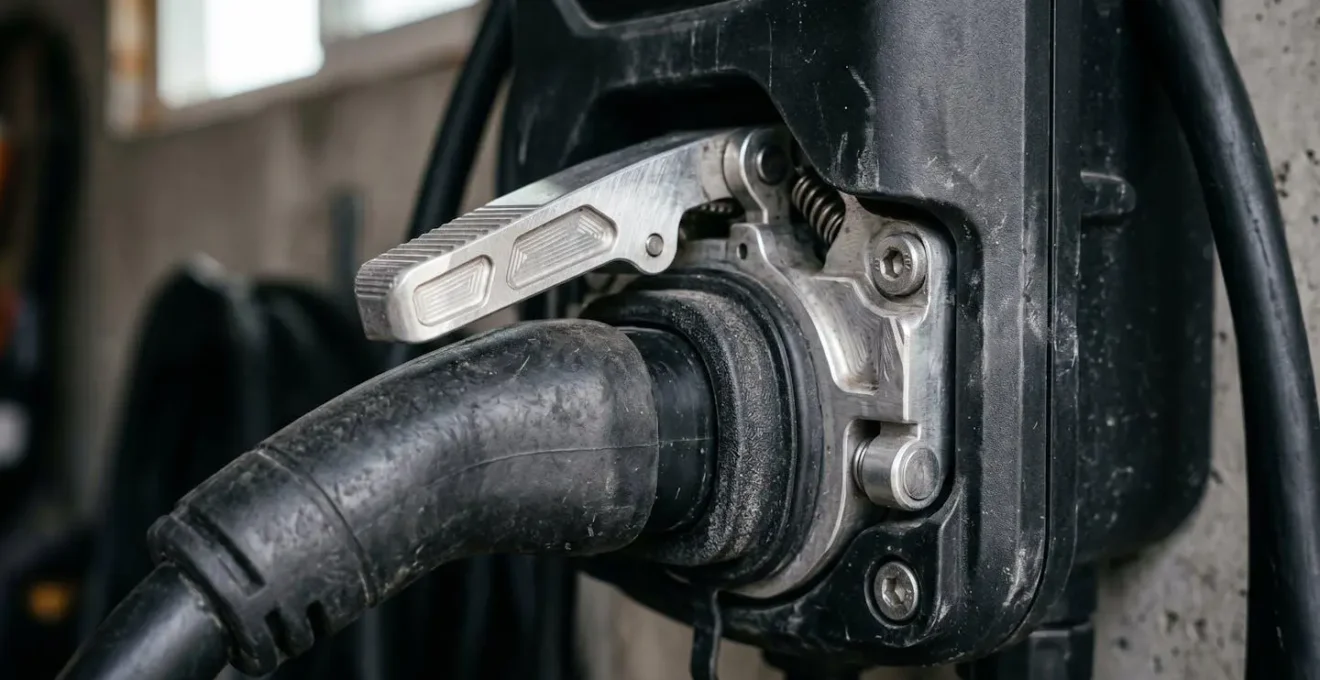
As shown, features like integrated locks and robust casings are your first line of defence. Ensuring your insurance provides a second line of financial protection is just as important for peace of mind.
Specialist EV Insurance vs Standard Policy: Which Covers Firmware Updates?
One of the most profound differences between a petrol car and an EV is the role of software. In a modern EV, firmware and over-the-air (OTA) software updates are not optional extras; they are fundamental to the vehicle’s performance, safety, and efficiency. These updates can enhance battery management, refine autonomous driving features, and patch critical security vulnerabilities. This concept of digital integrity is something standard insurance policies are ill-equipped to handle.
A standard policy is designed for a static, mechanical object. It covers physical damage. But what happens if a third-party repair shop performs a repair that prevents the car from receiving a critical safety update? Or if a faulty update applied during a service « bricks » an essential electronic control unit (ECU)? A standard policy will likely not cover this, viewing it as a mechanical or electronic failure rather than accident-related damage. This is where specialist EV insurance demonstrates its value.
As experts at Dick Lovett point out, many specialist policies explicitly include protection for software and firmware. This cover acknowledges that a failed update can be as debilitating as a physical collision. It ensures that if an authorised repair or update goes wrong, the subsequent electronic issues are covered. This is critical, as some updates tied to recalls or safety fixes can affect the warranty or legal status of the vehicle if not applied correctly. A specialist policy understands that maintaining the car’s software is synonymous with maintaining its safety and functionality.
Your 5-Point EV Insurance Policy Audit:
- Battery Clause: Check if the policy explicitly mentions cover for both owned and leased batteries. Look for the terms « write-off threshold » and « replacement value. »
- Charging Equipment: Verify if your wallbox is covered by home insurance. Confirm your car policy covers cables and adaptors against theft and damage, both at home and in public.
- Software & Firmware: Look for a clause that covers faults arising from official over-the-air (OTA) updates or software issues following a repair.
- Repair Network: Does the policy guarantee access to manufacturer-approved technicians who are certified to work on high-voltage systems and ADAS?
- OEM Parts Guarantee: Check if the policy includes « Original Equipment Manufacturer » (OEM) parts cover, especially if your vehicle is leased or under warranty.
The Breakdown Exclusion: Are You Covered if You Run Out of Charge?
The fear of running out of power far from a charging station—often called « range anxiety »—is a common concern for potential EV drivers. While modern EVs have increasingly impressive ranges, the possibility of getting stranded still exists. How your insurance and breakdown cover responds to this specific scenario is a critical question. Historically, breakdown policies have contained a significant exclusion: running out of fuel. For decades, this was seen as user error, not a genuine breakdown.
This precedent creates a crucial question for EV owners: is running out of charge treated the same as running out of petrol? The answer is, thankfully, changing. Most forward-thinking insurers and breakdown providers now recognise that the developing charging infrastructure can make « running flat » a more forgivable mishap. Major UK providers have adapted their services to address this unique EV problem. However, you should never assume this is included.
Many specialist EV insurance policies now bundle breakdown cover that explicitly includes « out of charge » assistance. As a major UK insurer like Admiral states, this is a specific feature of their EV policies. This service typically involves a roadside recovery vehicle providing a small top-up charge sufficient to get you to the nearest public charger, or, if that’s not possible, recovering your vehicle to your home or a nearby charging point. It’s essential to verify that your policy offers this and to understand its limitations. Does it cover you anywhere in the UK? How many times can you use the service per year? Is it a standard feature or a paid add-on? For an EV driver, this specific cover is not a luxury; it’s a fundamental part of a useful policy.

A remote roadside situation, as depicted above, is precisely when you need the assurance that your policy understands the difference between negligence and the realities of the current charging landscape.
When to Switch to an EV Tariff to Lower Your Overall Running Costs?
While insurance premiums can be higher, one of the most significant financial benefits of owning an EV is the dramatically lower cost of « fuel. » Charging an EV at home is almost always cheaper per mile than filling a tank with petrol. However, to maximise these savings, you need to be strategic about your electricity supply. Simply plugging into your domestic supply on a standard flat-rate tariff means you’re missing out on the biggest opportunity to reduce your running costs.
The right time to switch to a specialist EV electricity tariff is the moment you get your home wallbox installed. These tariffs are designed specifically for EV owners and work by offering a block of super-cheap, off-peak electricity hours, typically overnight between midnight and 5 am. By using your car’s or charger’s scheduling function to charge only during this window, you can reduce your cost per mile to just a few pence. This is particularly effective for those who do most of their mileage on a daily commute and can replenish the battery overnight.
As analysis from MoneyGeek highlights, the actual savings depend heavily on your local electricity rates. An EV tariff amplifies this saving by giving you access to the lowest possible rate. Some tariffs are even more sophisticated, offering « smart charging » that automatically adjusts the charging time to coincide with periods of low demand on the grid or high renewable energy generation, sometimes even paying you to export power back to the grid (Vehicle-to-Grid or V2G). Switching to an EV tariff transforms your car from a simple appliance into an integrated part of a smarter, cheaper energy system.
Charging an EV costs less per mile than filling a gas tank in most states. Actual savings depend on local electricity rates, gasoline prices and how much you drive.
– MoneyGeek Insurance Analysis, Electric Vehicle Insurance: Costs and Coverage in 2026
Why Your Sensors Must Be Recalibrated After a Bumper Repair?
Here we arrive at the core of why EV repairs are so complex and expensive, a concept we can call the « calibration cascade. » In a traditional petrol car, a bumper is a piece of plastic and metal. A minor prang might require a replacement, but the job is largely physical. In a modern EV, the bumper is a critical housing for an array of sensors—ultrasonic, radar, and cameras—that form the eyes and ears of your car’s Advanced Driver-Assistance Systems (ADAS).
These systems, which control everything from adaptive cruise control and automatic emergency braking to parking assistance, are extremely sensitive. As Insurify’s analysis points out, ADAS with multiple sensors and cameras are vulnerable to even minor collision damage. A slight misalignment of a bumper, a replaced windscreen, or even a new wing mirror can shift a sensor’s position by a fraction of a millimetre. To the human eye, it’s unnoticeable. To the ADAS, it’s a critical error that could cause the system to misjudge distances, fail to detect an obstacle, or brake unnecessarily.
Consequently, any repair to a part of the car that houses a sensor necessitates a full ADAS recalibration. This isn’t a simple plug-and-play task. It requires a controlled workshop environment, specialist diagnostic equipment, and certified technicians. This process alone can add hundreds of pounds to what would otherwise be a simple, cheap repair. As Western Pacific Insurance notes, repairs that were once basic now involve complex electronic testing. This calibration cascade is a primary driver of the high claim costs that lead to higher insurance premiums for everyone.
Body panels, mirrors, and bumpers may include sensors tied into the vehicle’s safety systems. Repairs that once involved basic parts now involve electronic testing and calibration, which increases claim costs.
– Western Pacific Insurance, Why Electric Vehicles Cost More to Insure (EV Insurance Explained)
How Sharing Your Apple Watch Data Can Lower Your Premium?
While the title mentions an Apple Watch, the principle is much broader and is revolutionising car insurance: telematics, or Usage-Based Insurance (UBI). Insurers are increasingly moving away from traditional risk assessment based on demographic data (age, postcode, occupation) and towards a model based on your actual driving behaviour. The technology in your car, and even on your wrist, can provide the data to prove you are a safe driver and earn you a lower premium.
UBI programmes work by using a telematics device—either a small « black box » installed in your car, a smartphone app, or data pulled directly from the car’s own connected systems—to monitor your driving habits. It measures factors like acceleration, braking, cornering speed, time of day you drive, and total mileage. For EV owners, this can be particularly beneficial. If you primarily make short, local trips and charge at home, your mileage will be low, a key factor in reducing your premium. Safe, smooth driving, which also happens to maximise battery range, will further lower your risk score.
As GEICO explains, options like their DriveEasy program tailor your policy to your actual habits. The data provides a transparent record of your risk profile. If the data shows you are a responsible driver, your premium is reduced accordingly. This is a powerful way to counteract the high base premiums associated with EVs. By agreeing to share your data, you are giving the insurer a clear, evidence-based reason to offer you a better price.
Case Study: The Impact of Usage-Based Insurance (UBI) for EV Drivers
Insurance providers are increasingly offering UBI programs that reward responsible driving. By monitoring habits via telematics, insurers can assess risk on behaviour rather than demographics. This is a major advantage for many EV owners who tend to drive shorter distances and exhibit safer driving patterns to conserve battery life. The system provides tangible benefits, with responsible drivers often seeing premium reductions of 10-30% based on verified data, directly offsetting the higher initial cost of EV insurance.
Key Takeaways
- The high cost of EV insurance is driven by the vehicle’s complexity as an integrated electronic system, not just its purchase price.
- Minor physical damage often triggers a « calibration cascade, » requiring expensive recalibration of safety-critical ADAS sensors.
- The lack of aftermarket parts for many EVs forces the use of costly Original Equipment Manufacturer (OEM) parts, inflating repair bills.
OEM vs Non-OEM Parts: Why Insist on Original Parts for Safety?
The final piece of the high-cost puzzle lies in the physical components themselves. In the world of petrol cars, a thriving aftermarket industry exists, producing non-original parts that are often significantly cheaper than those from the Original Equipment Manufacturer (OEM). For many standard repairs, using these parts is a common way to keep costs down. With electric vehicles, particularly from newer, tech-focused brands, this aftermarket simply doesn’t exist.
As a 2026 MoneyGeek analysis states, for many EVs, aftermarket alternatives don’t exist the way they do for gas-powered cars. Manufacturers like Tesla and Rivian maintain tight control over their supply chains, using proprietary components that can only be sourced directly from them. This lack of competition means insurers have no choice but to pay the manufacturer’s price for replacement parts, which is invariably higher. This component interdependence, where the hardware and software are designed to work exclusively with each other, is a key reason for high repair costs.
Furthermore, even when aftermarket parts might become available, their use can be problematic. Using a non-OEM part could compromise the intricate workings of the ADAS or even void the vehicle’s warranty. For leased vehicles, the use of OEM parts is often a contractual obligation. This is why a specialist insurance policy with an « OEM Parts Guarantee » is so valuable. It ensures that in the event of a repair, only manufacturer-approved parts will be used, preserving your car’s safety, performance, and warranty. While this cover might cost slightly more upfront, it protects you from the far greater costs of warranty disputes or safety system failures down the line.
Case Study: The Tesla & Rivian Proprietary Parts Challenge
Tesla and Rivian heavily rely on proprietary components with no aftermarket alternatives. When repairs are needed, insurers face long waits and high costs sourcing parts exclusively from the manufacturers. A MoneyGeek analysis found that full coverage for Tesla models regularly exceeded $2,800 per year, while an Audi SQ8 e-tron hit an astonishing $10,402. These high rates are primarily driven by the costs and delays associated with sourcing mandatory, proprietary OEM parts from a limited network of authorised repairers.
To protect your investment and ensure your safety, it’s crucial to move beyond a standard policy and seek out an insurer who understands the unique, integrated nature of your electric vehicle. The next logical step is to audit your current or potential policy against the specific needs of an EV, using the principles we’ve discussed to identify any critical gaps in cover.