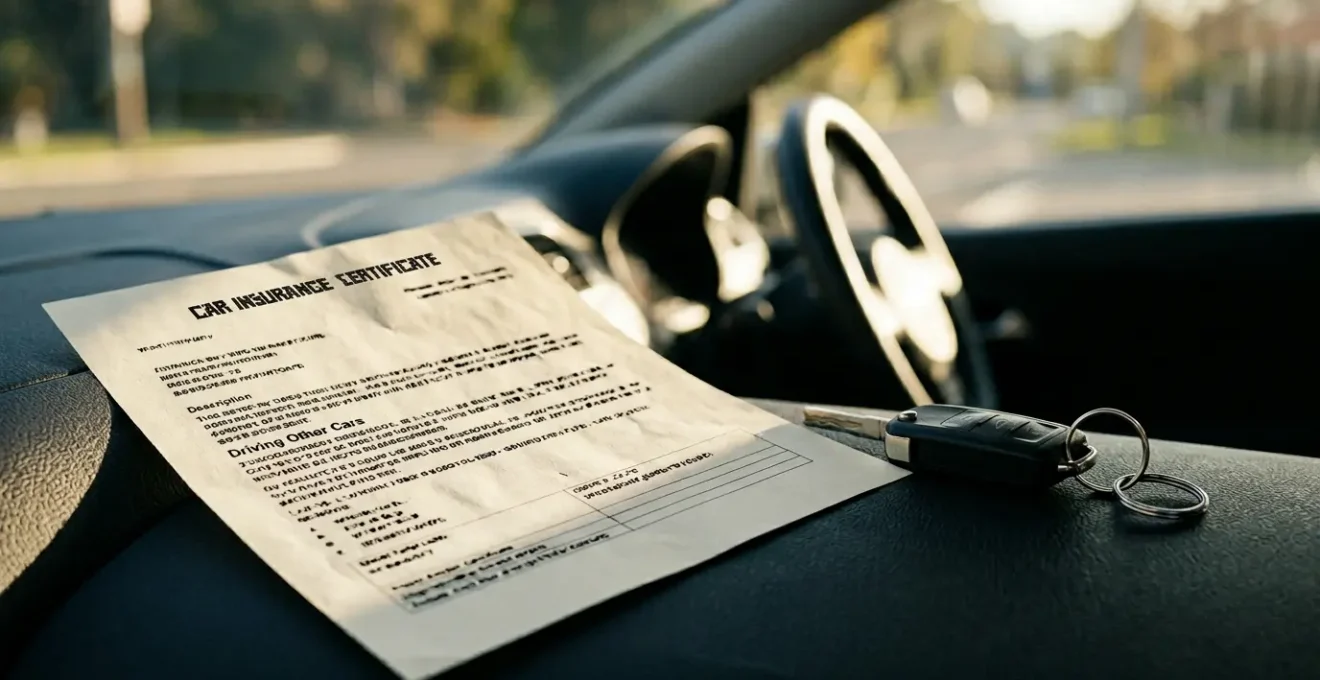
Contrary to popular belief, a ‘comprehensive’ policy is not a pass to drive any car. This common assumption is a legal minefield. This briefing exposes the harsh reality: Driving Other Cars (DOC) cover is virtually extinct for many, fronting is a prosecutable fraud, and your liability extends from the road right to your own front door. Understanding these hidden risks is not optional; it’s essential for your financial and legal survival.
There is a dangerous assumption held by countless UK drivers: that a comprehensive insurance policy is a golden ticket to drive a friend’s or family member’s car. This belief is not just wrong; it’s a fast track to being uninsured, facing fines, penalty points, and even a criminal record. The « Driving Other Cars » or DOC extension is a relic of a bygone era, and clinging to this myth is a high-stakes gamble.
The rules of the road are not merely suggestions, and insurance policies are legally binding contracts, not flexible guidelines. Insurers are not in the business of covering unassessed risk, and the police are not in the business of accepting excuses. This briefing is not a gentle reminder to « check your documents. » It is an authoritative warning about the specific invalidation triggers and legal tripwires you are likely unaware of. We will dissect the hard truths behind DOC cover, the legal line between a named driver and criminal fraud, and how your liability extends far beyond the driver’s seat.
This guide will systematically dismantle the dangerous myths surrounding UK insurance. We will examine why certain drivers are deemed too high-risk, how to navigate policy additions legally, the severe consequences of misrepresentation, and why even the most comprehensive-sounding cover has critical blind spots. Prepare to have your assumptions challenged.
Summary: Driving Other Cars (DOC) Extension: Are You Driving Illegally?
- Why Under-25s Rarely Get « Driving Other Cars » Cover?
- How to Add a Named Driver to Reduce Your Premium Legally?
- Fronting vs Named Driver: Where Is the Legal Line?
- The « Commuting » Mistake That Voids Cover for Sales Reps
- When to Remove a Named Driver to Protect Your No Claims Bonus?
- Why You Are Liable for Injuries to Trespassers on Your Property?
- Why « Super Cover » Still Doesn’t Include Tires and Glass?
- Public Liability for Homeowners: Are You Covered if a Delivery Driver Slips?
Why Under-25s Rarely Get « Driving Other Cars » Cover?
The idea that DOC cover is a standard feature of comprehensive insurance is a widespread and dangerous falsehood. For drivers under the age of 25, it is practically non-existent. This is not an arbitrary decision; it is a cold, hard calculation based on risk profiling. Insurers see younger drivers as a significant liability, and the data backs this position unequivocally. To an underwriter, extending cover to an unknown vehicle driven by a high-risk individual is an unacceptable gamble.
The statistics are stark. According to UK government data, drivers aged 17-24 represent just 6% of licence holders, yet they were involved in a staggering 24% of fatal and serious collisions in 2024. This disproportionate involvement in severe accidents makes them an extremely high-risk group. Consequently, insurers strip back policies for this demographic to the absolute minimum required by law, and optional extensions like DOC are the first to be removed.
This isn’t just about young drivers; the entire market has shifted. Industry analysis reveals that 96% of comprehensive car insurance policies do not include any form of DOC cover as a standard feature. Assuming you have it is a near-certain path to driving uninsured. The only safe course of action is to check your Certificate of Motor Insurance for the specific clause. If it is not explicitly stated, you are not covered. No exceptions.
How to Add a Named Driver to Reduce Your Premium Legally?
While DOC cover is a phantom for many, adding a named driver to a policy is a legitimate and common practice. For a high-risk main driver, such as a newly qualified one, adding an older, more experienced driver with a clean record can sometimes lower the overall premium. This is not a loophole; it’s a function of risk assessment. The insurer’s algorithm calculates that the vehicle will be used, at least some of the time, by a low-risk individual, which can statistically dilute the higher risk of the main driver.
The process is straightforward: you contact your insurer with the additional driver’s details, including their driving history and any convictions. The insurer then recalculates the premium based on this new, blended risk profile. However, this strategy comes with its own set of responsibilities and potential pitfalls. It is crucial to understand that the policy remains the property and responsibility of the main driver.
This distinction carries significant weight in the event of an incident. Make no mistake: if the named driver has an accident, the claim is made against the policyholder’s insurance. As experts at 1st Central Insurance warn, this has direct consequences for the person who owns the policy. They state:
If the named driver has a fault accident in the policyholder’s car, it is the policyholder’s No Claims Bonus that is affected, but the incident can still impact the named driver’s future premiums as they must declare it.
– 1st Central Insurance, Named Driver Car Insurance Guide
Adding a named driver is a tool for managing premiums, not for offloading responsibility. The ultimate legal and financial accountability rests with the policyholder.
Fronting vs Named Driver: Where Is the Legal Line?
The line between legally adding a named driver and committing insurance fraud is absolute, and crossing it has severe consequences. The act of « fronting » occurs when a more experienced driver is declared as the main user of a vehicle that is, in reality, primarily driven by a younger or higher-risk individual. This is a deliberate deception designed to secure a lower premium and constitutes a form of fraud.

Insurers are not naive. They employ sophisticated methods to detect this, analysing everything from telematics data to parking receipts and social media activity to determine the vehicle’s true primary user. The scale of insurance fraud is immense; data from the Association of British Insurers shows that UK insurers uncovered £1.16 billion in fraudulent claims in 2024 alone. This financial pressure means that suspected cases of fronting are investigated vigorously.
The consequences go far beyond a cancelled policy. Fronting is a criminal offense that can lead to prosecution. The short-term saving on a premium is trivial compared to the long-term damage. As the experts at WeCovr Insurance state, the repercussions are life-altering:
Getting caught for fronting doesn’t just cancel your policy; it can get you listed on the IFR [Insurance Fraud Register], making it extremely difficult and expensive to get any form of insurance for years to come.
– WeCovr Insurance Experts
The legal line is simple: the main driver must be the person who uses the car most frequently. Any other arrangement is a misrepresentation. Your legal culpability is not a grey area; it is black and white.
The « Commuting » Mistake That Voids Cover for Sales Reps
Another common invalidation trigger is the misunderstanding of vehicle « use ». Many drivers, particularly those in roles like sales, assume their standard « Social, Domestic, Pleasure and Commuting » (SDP+C) cover is sufficient for their work. This is a critical error. Standard commuting cover has a very narrow definition: it applies only to travel between your home and a single, permanent place of work. It does not cover travel to multiple sites, client visits, or other business-related journeys.
A sales representative travelling to various client locations, a tradesperson visiting different job sites, or even an employee attending a one-off training day at a different office are all engaged in « Business Use ». Failing to declare this to your insurer means you are effectively uninsured during those journeys. If an accident occurs, your insurer is within their rights to void the policy and refuse any claim, leaving you personally liable for all costs.
The distinction is subtle but absolute. Carrying company goods or samples, no matter how small, automatically classifies the journey as business use. To avoid any ambiguity, it is vital to understand what your policy defines as commuting versus business use. The following checklist clarifies the key distinctions.
Your Action Plan: Verifying Your Vehicle Use Class
- Review your policy for « Class of Use »: Identify if you have SDP, SDP+C, or Business Use (Class 1, 2, or 3).
- Analyse your work travel: List all types of journeys you make for your job. Do you visit multiple locations? Do you carry goods?
- Cross-reference with policy definitions: Compare your travel patterns to the strict definitions. Commuting is ONLY for travel to one regular workplace.
- Identify discrepancies: If you visit clients or multiple sites, you require at least Business Use Class 1.
- Contact your insurer immediately: If your declared use does not match your actual use, you must update your policy. Driving without the correct cover is driving uninsured.
This is not a detail to overlook. An insurer will use any discrepancy in your declared use as grounds to reject a claim. Your honesty and accuracy are your only protection.
When to Remove a Named Driver to Protect Your No Claims Bonus?
Just as adding a named driver can be a strategic move, knowing when to remove one is a crucial aspect of protecting your policy. A named driver is not a passive addition; their actions and driving record are directly linked to your insurance. You, as the policyholder, are vicariously liable for their behaviour in your vehicle. The most significant risk is to your No Claims Bonus (NCB), which can be wiped out by an accident caused by a named driver.
The decision to remove a named driver should be considered a proactive risk management measure. There are several key triggers for this. The most obvious is if the named driver is no longer using the vehicle. Paying an increased premium for a driver who poses no utility is a needless financial drain. More critically, if a named driver’s risk profile changes for the worse, you must act decisively.
As motor insurance specialists at WeCovr highlight, insurers assess all drivers on a policy with the same scrutiny. Their advice is clear:
When you add a named driver, the insurer assesses them using the same criteria as the main driver. Any driving convictions will significantly increase the premium.
– WeCovr Motor Insurance Specialists
If a named driver receives penalty points or, worse, a driving conviction, this must be declared to your insurer. This will almost certainly lead to a sharp increase in your premium. At this point, you must perform a cost-benefit analysis. Is the convenience of keeping them on the policy worth the increased cost and the heightened risk to your NCB? Often, the answer is no.
Why You Are Liable for Injuries to Trespassers on Your Property?
Your legal responsibilities do not end when you park your car and step onto your property. The concept of « duty of care » extends from the road to your own home, and its reach is often misunderstood. Many homeowners assume they have no responsibility for the safety of uninvited visitors or trespassers. This is a dangerous and legally incorrect assumption under UK law.

The Occupiers’ Liability Act 1984 establishes that a homeowner (the ‘occupier’) owes a limited duty of care to people other than their lawful visitors, including trespassers. This duty applies if the homeowner is aware of a danger on their property and knows, or has reasonable grounds to believe, that a trespasser may come into the vicinity of that danger. For example, if you have an unfenced pond, a dilapidated structure, or unsecured building materials, you could be held liable if a trespasser—even a child who wanders onto your land—is injured.
The law does not expect you to guarantee a trespasser’s safety, but it does require you to take reasonable steps to prevent injury from known hazards. This could involve putting up warning signs, repairing a broken fence, or safely storing dangerous items. Ignoring a known hazard on your property is a breach of this duty. If a trespasser is injured as a result of that specific hazard, you could face a substantial public liability claim. Your homeowners’ insurance may cover this, but failure to take reasonable precautions could complicate or even invalidate a claim.
Why « Super Cover » Still Doesn’t Include Tires and Glass?
The term « fully comprehensive » is one of the most misleading in the insurance industry. Many drivers upgrade to premium or « super » cover, believing it protects them against all eventualities. However, even these top-tier policies contain critical exclusions, most commonly for tires, windscreens, and other glass. This is not an oversight; it is by design, rooted in a core insurance principle.
Insurance exists to cover a « fortuitous loss »—a sudden, unforeseen, and accidental event. It is not a warranty or a maintenance plan. Items like tires, brakes, and windscreen wipers are subject to wear and tear. Their eventual failure is predictable and certain, not fortuitous. Insurers exclude these items from standard policies because their replacement is a maintenance cost, not an insurable risk. Glass is often treated similarly and bundled into separate, profitable add-on products.
This upselling strategy allows insurers to offer lower headline prices for their main policies. However, even purchasing a windscreen cover add-on may not provide the protection you expect in a modern vehicle. As noted by Lockton Insurance Brokers, the hidden costs can be significant:
Even with a glass add-on, the policy may not cover the mandatory and costly recalibration of Advanced Driver-Assistance Systems (ADAS) cameras, which are often mounted on the windscreen.
– Lockton Insurance Brokers, Insurance Guide to Driving Other Cars
Replacing a modern windscreen can run into thousands of pounds once the ADAS recalibration is factored in. Assuming your « super cover » includes everything is a costly mistake. You must read the specific exclusions list in your policy schedule.
Key Takeaways
- DOC cover is not standard on comprehensive policies; assuming you have it is extremely risky.
- « Fronting » is insurance fraud, not a clever trick. The legal and financial penalties are severe.
- Your vehicle’s « Class of Use » (e.g., commuting vs. business) must be 100% accurate or your policy is void.
- You are responsible for accidents caused by a named driver, and it is your No Claims Bonus that will be lost.
Public Liability for Homeowners: Are You Covered if a Delivery Driver Slips?
The duty of care you owe on your property is significantly higher for lawful visitors, such as delivery drivers, postal workers, or invited guests, than it is for trespassers. Under the Occupiers’ Liability Act 1957, you have a legal obligation to take reasonable care to ensure that these visitors will be reasonably safe in using your premises for the purpose for which they are invited. This is a much stricter standard.
This means you are responsible for maintaining your property to prevent foreseeable accidents. A slippery, moss-covered path, a broken paving slab, or a poorly lit set of steps can all become the basis for a public liability claim if a delivery driver slips and sustains an injury. The phrase « reasonable care » is key; you are not expected to create a perfectly hazard-free environment, but you are expected to identify and rectify obvious dangers.
The financial consequences of such a claim can be devastating, covering medical costs, lost earnings, and legal fees. While standard home insurance policies typically include public liability cover, a claim can still lead to increased premiums and the stress of a legal dispute. Furthermore, the overall economic impact of personal injuries is vast. To put it in perspective, while the context is different, UK government data estimates that road collisions alone resulted in £3 billion in NHS costs and a total economic loss of £6.9 billion in 2024. This illustrates the enormous financial scale associated with personal liability claims.
Simple maintenance is your best defence: keep paths clear, ensure adequate lighting, and fix any known hazards promptly. Your home is not just your castle; it is a space where your legal duty of care is active and enforceable.
The time for assumption is over. Your next step is not to browse for cheaper quotes, but to conduct a forensic review of your current policies. Contact your insurer, ask these precise questions, and demand written confirmation of your cover. What you don’t know can, and will, be used against you.