
A simple accident on your property can rapidly escalate into a complex and costly legal claim, and your standard insurance may not be the ironclad shield you believe it is.
- Your legal duty of care extends, to a degree, even to uninvited trespassers, not just lawful visitors like delivery drivers.
- Standard £1 million to £2 million liability cover can be exhausted by a single serious injury claim, especially if your property has high-risk features like a pond or trampoline.
- Your conduct immediately after an incident is critical; a seemingly harmless apology can be construed as an admission of liability, potentially voiding your insurance cover.
Recommendation: Proactively manage your legal exposure. This involves not only selecting appropriate insurance but rigorously documenting safety measures and understanding the precise policy wording that governs your defence.
The scenario is distressingly common for any property owner. A delivery driver, navigating a rain-slicked path to your door, loses their footing. In that moment, a routine delivery transforms into a potential liability nightmare. The immediate concern is for the individual’s wellbeing, but a secondary, colder anxiety quickly follows: « Am I legally responsible for this? » Most homeowners believe that their public liability insurance provides a simple, comprehensive answer. They follow the general advice to keep pathways clear and trust their policy will handle the rest.
However, in an environment of increasing litigation and a pervasive « compensation culture, » this passive approach is dangerously insufficient. True protection is not merely a line item in an insurance policy; it is a proactively constructed legal position. Building this defensible position requires a deeper understanding of your legal obligations, known as your ‘duty of care,’ which extends in nuanced ways you might not expect. It demands a strategic assessment of your property’s specific risks and a clear-eyed view of whether standard insurance limits are adequate for your potential exposure.
This guide moves beyond generic advice. We will deconstruct the legal framework that governs your liability, not as a sales pitch for insurance, but as a strategic manual for a cautious property owner. We will examine your obligations even to trespassers, analyse how to secure common hazards like garden ponds, and determine the appropriate level of cover for your specific circumstances. Most critically, we will dissect the precise conduct required in the aftermath of an incident to ensure you do not inadvertently sabotage your own legal defence. The goal is to shift your mindset from passive reliance on insurance to active management of your legal exposure.
This article provides a structured breakdown of the key legal and insurance considerations for property owners. The following sections will guide you through the critical areas of liability, risk mitigation, and defensive strategy to protect your assets.
Summary: A Homeowner’s Guide to Navigating Personal Injury Claims
- Why You Are Liable for Injuries to Trespassers on Your Property?
- How to Secure Your Garden Pond to Prevent Liability Claims?
- £1 Million vs £2 Million Liability Cover: Is Standard Cover Enough?
- The Dangerous Dogs Act Exclusion That Leaves Owners Exposed
- When to Admit Fault: Why Apologizing at the Scene Voids Your Cover?
- Custodial vs Insured Deposit Schemes: Which Protects You Better?
- Why You Need Legal Cover to Claim Back Your Excess?
- Motor Legal Protection: Is It Worth the £30 Add-On?
Why You Are Liable for Injuries to Trespassers on Your Property?
A common misconception among property owners is that liability ends at their property line for uninvited individuals. However, the law provides a more nuanced reality. While a trespasser is not afforded the same high level of protection as an invited guest (like a delivery driver or social visitor), property owners are not entirely absolved of responsibility. A specific ‘duty of care’ does exist, particularly when a known hazard is present and there is a foreseeable risk of injury. This principle is not a recent invention; it is a long-established part of property law designed to prevent harm from obvious and preventable dangers.
The legal foundation for this in the UK is the Occupiers’ Liability Act 1984, which imposes a duty of care on property owners towards individuals other than their lawful visitors. The law requires the occupier to take such care as is reasonable in all the circumstances to see that the trespasser does not suffer injury on the premises by reason of any danger. This duty is triggered if the owner is aware of a danger, knows or has reasonable grounds to believe that a trespasser may come into the vicinity of the danger, and the risk is one against which, in all circumstances, the owner may reasonably be expected to offer some protection.
Landmark Case: British Railways Board v. Herrington (1972)
This pivotal case established the modern framework for trespasser liability. A child was severely injured after trespassing onto a live railway line through a gap in a fence that the railway board knew was frequently used by children. The House of Lords ruled in the child’s favour, establishing that occupiers have a duty of « common humanity » (now a duty of care) to trespassers, particularly children who may not appreciate the danger. This ruling emphasized that where an occupier knows of a hazard and the likelihood of trespass, they must take reasonable and practical steps to mitigate the risk, forming the basis of current UK law.
Therefore, a homeowner with a deep, unfenced pond, a dilapidated structure, or exposed wiring cannot simply claim a victim was « trespassing » as a complete defence. If the hazard is known and access is not reasonably restricted, a significant legal exposure exists. The key takeaway for a property owner is that liability is not a question of invitation, but of foreseeable risk and reasonable preventative action.
How to Secure Your Garden Pond to Prevent Liability Claims?
A garden pond, while a feature of aesthetic beauty, represents a significant liability hazard, particularly concerning children. Following the legal principles of foreseeable risk established in the previous section, failing to adequately secure a pond is a direct failure in an owner’s duty of care. A proactive and documented approach to safety is the most robust defence against a potential claim. Implementing a multi-layered security system demonstrates a commitment to reasonable care that is difficult to dispute in a legal setting. This involves creating physical barriers, providing clear warnings, and potentially using alert systems.
The objective is to create a demonstrable record of proactive risk mitigation. This goes beyond mere installation; it involves regular maintenance and logging your safety checks. This documentation serves as crucial evidence that you have not been negligent and have taken your responsibilities as a property owner seriously. An insurer defending a claim on your behalf will find such a record invaluable. The following checklist outlines a comprehensive system.
Your Action Plan: The Three-Layer Pond Security System
- Layer 1 – Physical Barriers: Install lockable fencing around the entire pond perimeter. The gate must be self-closing and self-latching. Additionally, consider fitting rigid metal mesh grilles directly over the water’s surface, strong enough to prevent a child from falling in.
- Layer 2 – Deterrent Warnings: Erect clear, unambiguous signage. This should include « Private Property » notices and specific hazard warnings like « Deep Water » or « Danger: Pond. » These signs must be visible from all potential angles of approach.
- Layer 3 – Alert Systems: For enhanced protection, consider installing a pond alarm. These devices detect disturbances on the water’s surface and trigger an audible alert, providing immediate notification of an unauthorised entry or fall.
- Documentation: Maintain a detailed maintenance log. Regularly photograph and date your checks of the fences, locks, grilles, and signage. This log becomes irrefutable proof of your ongoing commitment to safety management.
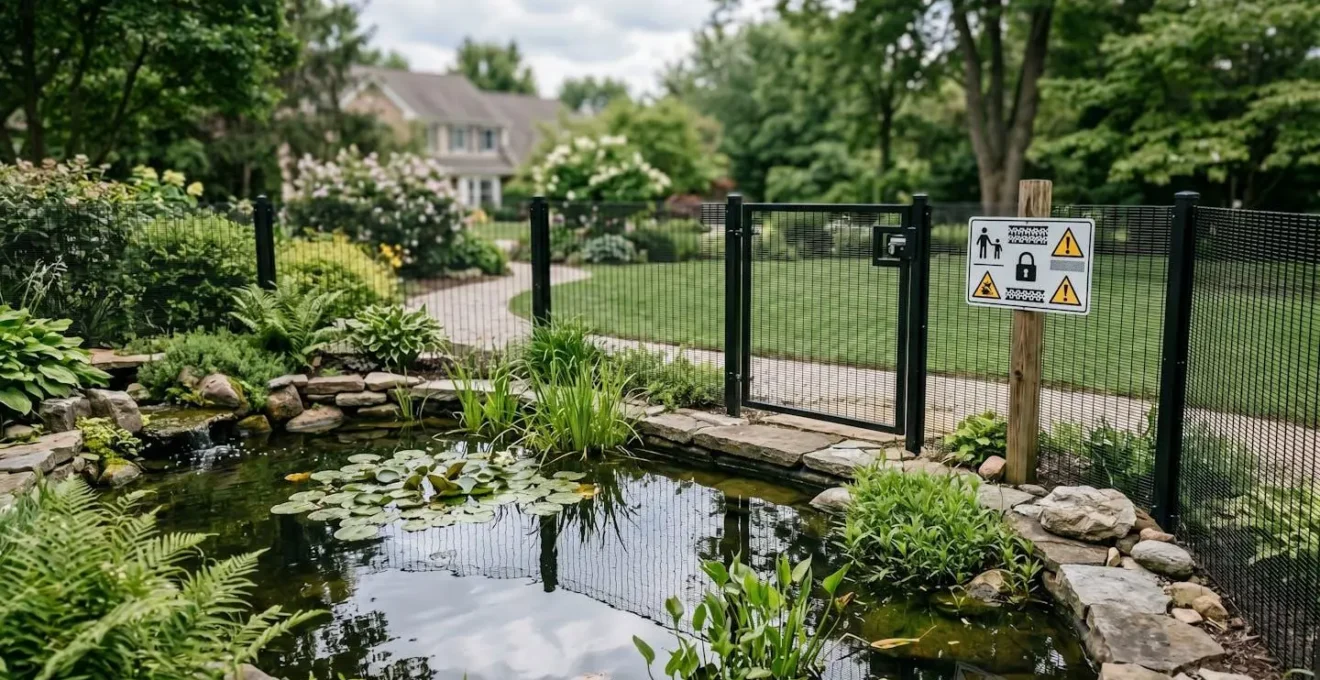
As the illustration demonstrates, security measures can be integrated tastefully into the landscape. The focus is on effectiveness, not aesthetic disruption. A secure perimeter, a locked gate, and a physical barrier over the water surface form a powerful combination that makes it exceedingly difficult for a claimant to argue the property owner was negligent.
£1 Million vs £2 Million Liability Cover: Is Standard Cover Enough?
Most standard home insurance policies in the UK include public liability protection, but the level of cover, or ‘limit of indemnity’, is not uniform. The most common offerings provide a safety net for claims made against you, but understanding whether the « standard » amount is sufficient requires a careful assessment of your personal risk profile. For many homeowners, a policy that provides £1 million in cover seems like an immense sum, yet it can be alarmingly insufficient in the face of a catastrophic injury claim. The costs associated with lifelong care, loss of earnings, and extensive legal fees can quickly erode a standard limit.
Typically, personal liability insurance in the UK commonly ranges from £1 million to £2 million as a standard inclusion, with options to increase this significantly. Deciding whether to upgrade is not a matter of guesswork; it is a calculated decision based on the specific hazards present on your property. Homeowners with features like swimming pools, trampolines, large trees, or those who frequently host guests or have tradespeople on site face a higher level of legal exposure. For these individuals, a £1 million limit may represent a critical shortfall in protection. The modest increase in annual premium for higher cover is often negligible compared to the financial devastation of an underinsured claim.
The following table, based on an analysis of indemnity insurance levels, breaks down the typical use cases for different coverage limits, helping you to evaluate your own needs against industry benchmarks.
| Coverage Limit | Typical Use Case | Catastrophic Injury Coverage | Annual Premium Impact |
|---|---|---|---|
| £1 Million | Standard residential homeowners, low-risk properties | May be exhausted by serious single injury claim | Baseline premium |
| £2 Million | Homeowners with pools, trampolines, or regular visitors | Provides buffer for serious injuries with ongoing care costs | Modest increase (£20-50/year) |
| £5 Million | High-value properties, home businesses, multiple hazards | Comprehensive protection including legal defense and multiple claimants | Moderate increase |
| Umbrella Policy | Sits on top of home and auto insurance for extended protection | Adds millions in additional liability coverage cost-effectively | Highly cost-effective per £1M coverage |
Ultimately, selecting the right level of cover is about aligning your insurance protection with your real-world risk. An honest audit of your property and lifestyle is the first step towards ensuring your financial assets are adequately shielded. The question is not just « Am I covered? », but « Am I covered enough for my specific level of risk? ».
The Dangerous Dogs Act Exclusion That Leaves Owners Exposed
Liability arising from dog-related incidents is a significant and growing concern for property owners. The issue is far more widespread than many believe; in 2024 alone, police data shows there were 31,920 recorded dog attacks in England and Wales. While the Dangerous Dogs Act 1991 specifically bans certain breeds, a critical misunderstanding is that liability is limited to these dogs alone. In reality, the law holds an owner responsible if their dog is « dangerously out of control » in any place, including their own home, regardless of breed. This means a bite or injury caused by any dog, from a Terrier to a Labrador, can result in criminal charges for the owner and a civil claim for the victim.
This is where a crucial insurance exclusion comes into play. Many home insurance policies will explicitly deny public liability cover for any claim arising from a dog that is required to be registered under the Dangerous Dogs Act. More importantly, they will also deny cover if a claim arises from a non-banned breed that has a known history of aggression. If your dog has previously bitten someone or shown aggressive tendencies, your insurer could argue that you were aware of the risk and failed to mitigate it, thereby voiding your cover for a subsequent incident. This leaves the owner personally exposed to the full financial and legal consequences of a claim.

The only robust defence is responsible ownership and meticulous control. This involves professional training, secure containment on your property (e.g., strong fences, locked gates), and using a lead in public spaces. As shown, a well-trained dog under the calm control of its owner presents a starkly different liability profile than an uncontrolled animal. Should an incident occur, being able to provide evidence of training, veterinary care, and consistent responsible handling can be a powerful tool in your legal defence and in discussions with your insurer.
The onus is on the owner to demonstrate a pattern of responsible behaviour. Insurers and courts will look less at the breed and more at the owner’s actions and the dog’s history. A failure to control any dog can lead to a devastating personal liability claim that your insurance will not cover.
When to Admit Fault: Why Apologizing at the Scene Voids Your Cover?
In the immediate aftermath of an accident on your property, the human impulse is to show concern and offer an apology. However, from a legal and insurance perspective, this can be a catastrophic mistake. An apology, particularly one that accepts blame (« I’m so sorry, I should have fixed that loose step »), can be legally interpreted as an « admission against interest. » This means you have formally admitted liability for the incident. Almost all public liability insurance policies contain a strict clause that prohibits the policyholder from admitting fault, negotiating, or promising any payment without the insurer’s express consent. Breaching this clause can give your insurer grounds to void your cover entirely.
This leaves the property owner in a difficult position: how to show genuine human empathy without compromising one’s legal standing and insurance protection. The solution lies in mastering the art of the non-admission apology. This involves expressing sympathy for the person’s situation and offering practical assistance (calling for help, offering a place to sit) while meticulously avoiding any words that assign or accept blame. Your focus should be on the injured person’s welfare, not on the cause of the incident. Immediately after, you must privately and thoroughly document the scene and the conversation for your insurer.

Your smartphone is an essential tool in this moment. The priority is to create a contemporaneous record of the event while details are fresh. This record is a cornerstone of building your defensible position. The following action plan provides clear scripts for safe communication.
Your Action Plan: What to Say (and Not Say) After an Incident
- Empathy Statement (SAFE): Use phrases like, « I’m so sorry you fell. Are you okay? Let me help you. » This expresses human concern without admitting legal fault for the cause of the fall.
- Admission of Liability (AVOID): Never say, « I’m so sorry my icy step caused you to fall. I should have cleared it. » This directly compromises your insurance defence by accepting responsibility.
- Neutral Response (SAFE): A safe alternative is, « That must have been frightening. Please sit down and let me call for assistance if you need it. » This shows care while preserving your legal position.
- Focus on Welfare (SAFE): You can ask, « Can you tell me what happened? » but frame it as concern: « I want to make sure you get the right care. » This gathers information without assigning blame.
- Immediate Documentation: Use a notes app on your phone to privately record the exact statements made by all parties, the time, weather conditions, the state of the property, and details of any witnesses. Take photos of the area. This is for your insurer only.
Custodial vs Insured Deposit Schemes: Which Protects You Better?
For landlords, managing tenant relationships involves specific legal obligations, and deposit protection is a primary one. The choice between a custodial scheme (where the scheme holds the money) and an insured scheme (where the landlord holds the money but pays for insurance on it) is often seen as a simple administrative decision. However, this focus on the financial deposit can create a dangerous blind spot. These schemes protect the tenant’s money; they offer zero protection to the landlord against personal injury claims that occur on the rental property. A landlord’s liability exposure is significantly different and often greater than that of a standard homeowner.
The property is an income-generating asset, and the law imposes a clear duty of care on the landlord to ensure it is safe for tenants and any visitors, including delivery personnel and tradespeople. Standard homeowner’s insurance is typically inadequate for a rental property, as it may exclude claims related to commercial activity (i.e., letting). A specialised landlord insurance policy, with a robust property owners’ liability component, is not an optional extra; it is a fundamental requirement for managing this heightened risk.
A claim can arise from any aspect of the property’s maintenance, from a faulty handrail to a poorly maintained garden path. Without the correct insurance, the landlord is personally liable for the entirety of the compensation and legal costs, which can be financially ruinous.
Landlord Liability Claim: Postman Injured at a Rental Property
A postman was delivering mail to a rental property when a manhole cover on the path gave way, causing him to fall and break his leg. Solicitors acting on behalf of the injured postman quickly filed a claim against the property owner. Fortunately, the landlord had a specific landlord insurance policy that included £2 million in property owners’ liability cover. The policy responded as intended, covering the full amount of compensation awarded to the postman as well as all associated legal defense costs. This case starkly demonstrates the critical importance of specialised landlord liability protection, which operates entirely separately from any tenancy deposit scheme.
This illustrates that while deposit schemes are a legal necessity for protecting tenant funds, the landlord’s primary shield against physical injury claims is a dedicated liability insurance policy. Confusing the two or assuming a homeowner’s policy is sufficient is a common and costly error.
Why You Need Legal Cover to Claim Back Your Excess?
In the complex world of insurance, even a ‘non-fault’ incident can leave you out of pocket. Imagine a delivery van collides with your garden wall. The driver is clearly at fault, and their insurer will eventually pay for the repairs. However, to initiate the claim and get the repairs started promptly, you often have to claim on your own home insurance policy and pay your compulsory excess. Recovering this excess from the at-fault party’s insurer can be a slow and arduous process. This is where a little-understood policy add-on, Legal Expenses Insurance, becomes invaluable. It provides the financial resources to pursue legal action to recover your uninsured losses, like your excess.
This type of cover typically comes in two forms: Before-the-Event (BTE) and After-the-Event (ATE) insurance. For a homeowner, BTE is the strategic choice. It is purchased as a low-cost add-on to an existing home insurance policy *before* any incident occurs. ATE, in contrast, is purchased *after* an incident to fund a specific lawsuit and is substantially more expensive and harder to obtain. BTE cover is designed for precisely these kinds of consumer disputes, providing access to legal advice and covering the costs of litigation to reclaim your money.
Without BTE cover, the cost of hiring a solicitor to recover a £250 or £500 excess would be prohibitive. Most people would be forced to write it off as a loss. With BTE, the policy funds the legal action, ensuring you are made whole. The following table clarifies the significant strategic differences between these two types of legal protection.
| Feature | Before-the-Event (BTE) Legal Cover | After-the-Event (ATE) Legal Insurance |
|---|---|---|
| When Purchased | As add-on to existing home insurance policy before incident occurs | Purchased after an incident to fund a specific lawsuit |
| Annual Cost | Cheap add-on (typically £20-40 per year) | Much more expensive, often hundreds to thousands of pounds |
| Coverage Scope | Broad: excess recovery, property disputes, consumer disputes, employment issues | Narrow: specific to the single incident/claim being pursued |
| Strategic Value | Funds proactive defense actions (engineer reports, expert witnesses) + excess claims | Limited to funding lawsuit costs for claim already in progress |
| Activation | Already in place when needed, immediate access | Requires application and approval after incident, may be declined |
Therefore, BTE legal cover is not just for defending claims against you; it is also an offensive tool for asserting your own rights and recovering money that is rightfully yours. It is a small investment that provides significant leverage in common consumer and property disputes.
Key takeaways
- Your legal duty of care extends to all individuals on your property, including trespassers, if a known hazard exists.
- Proactive and documented safety measures (fencing, warnings, maintenance logs) are your strongest legal defence against a liability claim.
- Your words and actions at the scene of an incident have legal weight; expressing empathy without admitting fault is a critical skill to protect your insurance cover.
Motor Legal Protection: Is It Worth the £30 Add-On?
Motor Legal Protection is a familiar, low-cost add-on for most drivers, designed to help recover uninsured losses after a non-fault road accident. A similar concept, Home Legal Protection or Legal Expenses Insurance, exists for property owners. Often offered for a nominal annual fee of around £30, these policies promise to cover legal costs for a range of disputes, from property and consumer issues to employment tribunals. The low price point makes it an easy upsell, but the true value of this cover lies not in its price, but in its lengthy list of exclusions.
From a defence lawyer’s perspective, the most critical exclusion to scrutinise is the « prospect of success » clause. This provision allows the insurer to refuse to fund a case if they deem it has a low chance of winning. The definition of « low prospect » and who makes this determination (often an in-house solicitor) can be opaque, giving the insurer significant power to deny cover. Furthermore, these policies are not a catch-all for legal troubles. They almost universally exclude costly and common areas of law like matrimonial disputes, defamation, and issues that existed before the policy began.
Another significant limitation can be the restriction on your choice of solicitor. Many cheaper policies mandate the use of a lawyer from the insurer’s « panel. » While these panel firms are competent, they may not have the specialist expertise required for a complex property dispute. The freedom to choose your own legal expert is a valuable right that is often surrendered with a low-cost policy. Before adding this cover, a thorough review of the policy wording is not just recommended; it is essential.
Your Action Plan: Key Exclusions to Scrutinise in Your Legal Protection Policy
- Prospect of Success Exclusion: Check how your policy defines a « reasonable prospect of success » (often 51% or higher) and who makes the final assessment. A vague definition gives the insurer more discretion to decline your claim.
- Matrimonial and Family Law: Be aware that legal disputes related to divorce, separation, or child custody are almost always excluded from standard home legal protection policies.
- Defamation Claims: Cases involving libel (written) and slander (spoken) are a common exclusion. Do not assume this policy will cover a dispute over online comments or community disagreements.
- Choice of Solicitor Restriction: Carefully read the policy wording to see if you are forced to use a solicitor from the insurer’s panel. If you have a preferred local or specialist firm, this policy may prevent you from using them.
- Pre-existing Disputes: The policy will not cover any legal issue or dispute that had already started, or where the root cause was known, before the policy’s inception date or during an initial qualifying period (often 30-90 days).
The most critical next step, therefore, is not to seek more coverage blindly, but to conduct a thorough review of your current policy documents and property safety measures. Understanding your existing protection and identifying vulnerabilities is the cornerstone of a robust legal defense. Contact your insurance advisor to discuss your specific risk profile and ensure your coverage is adequate for your legal exposure.