Securing affordable flood insurance isn’t about just finding a Flood Re-backed policy; it’s about understanding and mitigating the specific risks insurers penalise you for.
- Policy wording is critical: « Groundwater » flooding is often excluded, and your block of flats may be ineligible for buildings cover entirely.
- Undervaluing your rebuild cost is a major trap, as the ‘average clause’ can cut your final claim payout by the percentage you were underinsured.
Recommendation: Treat your property as a risk portfolio. Proactively install resilience measures and obtain a professional rebuild cost valuation to strategically de-risk your home and strengthen your position with insurers.
For residents in UK flood plains, the search for affordable home insurance can feel like a losing battle against rising tides and escalating premiums. The standard advice often circles back to the Flood Re scheme, a government-backed initiative designed to make flood cover more accessible. While essential, simply looking for a Flood Re policy is often not enough. Many homeowners follow this advice only to be met with outright rejections, prohibitively high excesses, or crippling policy exclusions they only discover after a disaster.
The core issue is a disconnect. Homeowners see a property to protect; insurers see a complex portfolio of quantifiable risks. The platitudes of « shopping around » or « installing sandbags » fail to address the fundamental drivers of an insurer’s decision: the granular details of the contract and the physical reality of the property’s vulnerability. This is the insurability gap where so many fall through.
But what if the key wasn’t just to find a policy, but to fundamentally change how an insurer views your property? This guide adopts the perspective of a climate risk assessor. We will move beyond the basics to dissect the system itself. Instead of just telling you what to do, we will explain *why* certain properties are excluded, how specific policy clauses can void your cover, and where the real financial dangers lie—not in the floodwater itself, but in the small print of your documents.
By understanding the contractual granularity and the principles of physical risk mitigation, you can transform from a passive applicant into an active risk manager of your own home. This article will deconstruct the key challenges and provide a strategic framework for navigating the complexities of insuring a home in a high-risk flood zone, empowering you to secure the cover you need.
This article provides a detailed breakdown of the critical factors influencing your ability to secure effective flood insurance. Explore the sections below to understand the specific risks and solutions relevant to your situation.
Summary: Navigating the Complexities of UK Flood Insurance
- Why Your Flat Might Not Qualify for the Government Flood Re Scheme?
- How to Install Flood Gates to Lower Your Insurance Excess?
- Storm Damage or Flood: Which Definition Covers Rising Groundwater?
- The « Act of God » Myth: Does It Still Exist in Modern Policies?
- When to Move Furniture Upstairs During a Met Office Red Warning?
- Why Undervaluing Your Rebuild Cost Cuts Your Claim by 50%?
- The EPC « C » Rating Rule That Could Make Your Rental Illegal
- Buildings Insurance: How to Calculate Rebuild Cost Correctly?
Why Your Flat Might Not Qualify for the Government Flood Re Scheme?
One of the most significant and misunderstood limitations of the Flood Re scheme concerns blocks of flats. While the scheme is a lifeline for many, a critical structural exclusion leaves a vast number of leaseholders exposed. The scheme is designed for individual domestic properties, and its rules define properties in buildings with four or more flats as commercial entities for the purpose of buildings insurance. This distinction is not just semantic; it creates a major insurability gap. According to the British Insurance Brokers’ Association, up to 1 million householders in blocks of more than three flats are excluded from Flood Re buildings cover.
This means that while a leaseholder can get a Flood Re-backed policy for their contents, the building itself—the structure they are financially tied to via a service charge—cannot benefit. The freeholder must secure a commercial block policy, which is not eligible for the scheme and is often astronomically expensive or even impossible to obtain in high-risk flood zones. This leaves leaseholders paying high service charges for inadequate cover, or worse, living in a building with no flood insurance at all. The property’s construction date is another key factor; any property built after 1 January 2009 is automatically ineligible, a rule designed to discourage new developments in flood-prone areas.
For leaseholders, navigating this complex situation requires proactive investigation. You cannot assume you are covered. You must verify the specifics of the building’s master policy and your own eligibility. The following checklist provides a clear path to determine your standing and what actions to take if you find yourself outside the protection of Flood Re.
Your Action Plan: Leaseholder’s Flood Re Eligibility Check
- Verify Construction Date: Confirm your building was constructed before 1 January 2009. Any property built after this date is automatically ineligible for Flood Re.
- Check Block Size: Confirm your block contains three flats or fewer. Buildings with four or more flats are excluded from buildings cover under the scheme.
- Request the Block Policy: Ask your management company for a copy of the freeholder’s block policy. Check if it is a domestic policy or a commercial landlord insurance policy.
- Review Your Lease: Scrutinise your lease agreement to identify who is responsible for the buildings insurance and how these costs are passed on to you via the service charge.
- Seek Specialist Help: If you are ineligible for Flood Re, immediately contact a BIBA-registered specialist broker. They have access to manual underwriting markets like Lloyd’s of London that can provide bespoke cover.
How to Install Flood Gates to Lower Your Insurance Excess?
For insurers, a property in a flood zone is a liability waiting to happen. The key to lowering your premiums or excess is to change this perception by demonstrating proactive physical risk mitigation. While sandbags offer a temporary, porous barrier, insurers are far more interested in permanent, professionally installed flood resilience measures. Flood gates, or barriers, are a prime example. These are not simply panels you place in a doorway; they are engineered systems with airtight seals and robust frames that significantly reduce the likelihood of water ingress during a flood.
From a risk assessor’s viewpoint, installing a Kitemarked flood gate is a clear signal that you are actively reducing the potential for a claim. While insurers are often reluctant to promise specific discounts, recent property insurance guidance notes that flood resilience measures can lead to reduced premiums or a lower compulsory excess. The logic is simple: a property with effective defences is less likely to suffer extensive, costly damage, making it a better risk. When applying for or renewing your policy, you must declare these improvements and provide documentation, such as installation certificates, to ensure they are factored into the underwriting process.
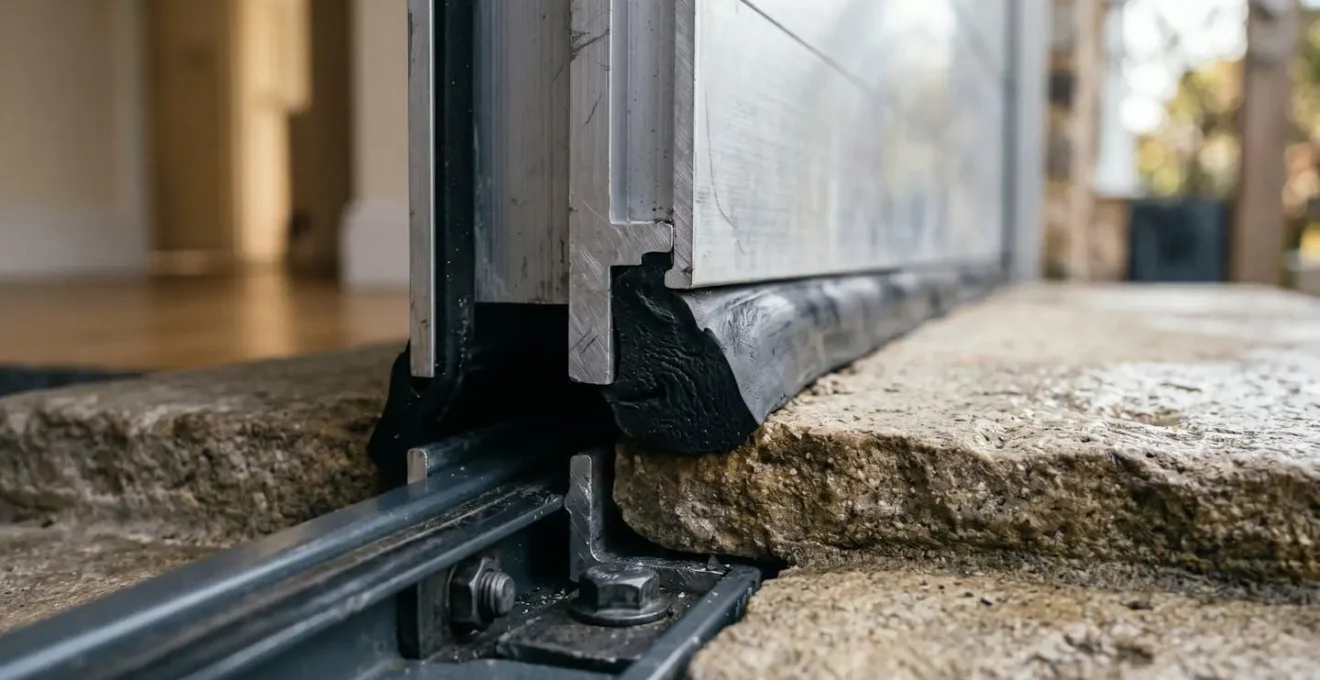
The image above showcases the professional-grade construction of a modern flood barrier. The focus is on the sealing mechanism and robust materials, which are the elements an underwriter is interested in. It’s this level of tangible protection that can make a material difference to your insurance terms. Other valuable measures include installing non-return valves on drains to prevent sewage backup, using water-resistant plaster on ground floors, and raising electrical sockets well above the likely flood level. Each improvement adds a layer of defence, collectively lowering your property’s overall risk profile.
Storm Damage or Flood: Which Definition Covers Rising Groundwater?
One of the most dangerous areas of contractual granularity in home insurance is the distinction between different types of water damage. Homeowners often assume that if their property is inundated, it will be covered as a ‘flood’. However, the source of the water is paramount, and many policies contain a critical exclusion for damage caused by rising groundwater. This is not an obscure clause; a 2025 Which? analysis revealed that 38% of UK home insurance policies explicitly exclude flooding caused by a rise in the water table. This means that if your home is damaged by water seeping up from the ground after a period of prolonged rainfall, rather than from an overflowing river or surface run-off, your claim could be rejected outright.
Insurers make this distinction because groundwater flooding is often a slow, pervasive, and highly destructive event that is difficult to predict and model. The Financial Ombudsman Service (FOS) has handled numerous disputes over this very issue. As they clarify in their guidance, « a flood does not have to be a sudden and violent event ». This nuance is critical, as a slow-moving flood from a high water table is still a flood, but it may be one your specific policy chooses not to cover. A case study highlights the severe financial implications.
Case Study: The Golf Course Groundwater Dispute
A golf course in the UK filed a claim after waist-deep flooding in December 2019. The insurer rejected it, pointing to a policy exclusion for any damage caused by a ‘change in water table level’. The Environment Agency confirmed the flooding was due to the water table being at its highest level since 1975. The policyholder argued that severe storms were the ultimate cause, but the Financial Ombudsman ruled in favour of the insurer. It determined that the groundwater flooding had already begun before the storms hit and the specific exclusion in the policy was clear and unambiguous, leaving the business to bear the full cost of the damage.
This case underscores the absolute necessity of reading and understanding your policy’s definition of ‘flood’ and its list of exclusions. If your property is in an area known for high groundwater levels, you must ensure your policy provides cover for this specific peril or risk facing an uninsured loss.
The « Act of God » Myth: Does It Still Exist in Modern Policies?
The term « Act of God » is a persistent myth in the world of insurance. Many people believe that insurers can use this vague, archaic phrase to avoid paying out for damage caused by extreme natural events like storms or floods. In reality, modern insurance policies have evolved. The concept has been replaced by a much more precise system of named perils. As industry practice dictates, « Modern policies use specific named perils. If the event is a named peril in the policy, it’s covered ». This means your policy will explicitly list the events it covers, such as ‘storm’, ‘flood’, ‘fire’, and ‘subsidence’.
If your home is damaged by an event that is listed as a named peril in your policy, the insurer is obligated to cover the loss, regardless of how severe or « unprecedented » the event was. The debate then shifts from whether it was an ‘Act of God’ to whether the event meets the policy’s definition of the named peril. For example, some policies define a ‘storm’ using specific criteria from the Beaufort scale (e.g., wind speeds of 47-54 mph). However, many policies do not provide a definition, which can lead to disputes. In these cases, the Financial Ombudsman Service (FOS) often steps in to provide a common-sense interpretation, which typically works in the policyholder’s favour.
Case Study: The Collapsed Garden Wall
After a period of torrential rain and flash flooding, Ms D’s garden wall collapsed. Her insurer, despite having no definition of ‘storm’ in the policy, rejected her claim, arguing the weather wasn’t severe enough and the wall was in poor condition. The FOS intervened and decided that the torrential rainfall was well above the minimum conditions to be considered a storm and was the most likely cause of the collapse. As highlighted in a Which? analysis of insurance disputes, the FOS upheld her complaint and ordered the insurer to pay for the damage. This demonstrates that insurers cannot invent their own restrictive definitions after the fact to deny valid claims under a named peril.
This shift from ‘Act of God’ to named perils puts the power back in the hands of the informed consumer. Your task is not to worry about divine intervention, but to ensure the perils your property is most at risk from—especially flood and storm—are clearly named and defined favourably within your policy document.
When to Move Furniture Upstairs During a Met Office Red Warning?
When a flood is imminent, timing is everything. Moving furniture, valuables, and electrical goods to an upper floor can save thousands of pounds in losses, but acting too early can cause unnecessary disruption, while acting too late is disastrous. The official UK flood warning system, managed by the Environment Agency, is designed to provide a clear, tiered action plan. Understanding the lead time is critical; according to Environment Agency flood forecasting guidance, river flooding often gives hours or even days of warning, whereas flash flooding from surface water may provide only minutes.
A Met Office Red Warning for rain is the highest alert and signifies a ‘danger to life’. This is often issued in conjunction with a Severe Flood Warning from the Environment Agency. However, you should not wait for a Red warning to act. The time to move your belongings is when a Flood Warning (Amber) is issued. This alert means flooding is expected and immediate action is required to protect yourself and your property. Waiting for a Severe Flood Warning (Red) is too late; at that stage, the priority must be the preservation of life, which means evacuating immediately if instructed to do so.
Following the official guidance is not just crucial for safety; it also demonstrates to your insurer that you have taken reasonable steps to mitigate your loss, which is a standard condition in most policies. The three-tier system is your definitive guide to action.
Your Flood Warning Action Guide
- Flood Alert (Yellow): Prepare. This is the time to monitor local water levels online. Check that your flood kit is accessible and review your family’s evacuation plan. No immediate action to move belongings is required, but you should be ready.
- Flood Warning (Amber): Act Now. This is the trigger point. Move valuables and furniture upstairs. If it is safe to do so, turn off your gas, electricity, and water at the mains. Deploy any flood protection measures you have, such as barriers or sandbags, and prepare to evacuate.
- Severe Flood Warning (Red): Danger to Life. Your priority is now personal safety. Evacuate immediately if instructed to do so by emergency services. Do not attempt to return to your property until authorities confirm it is safe. If possible, document your actions with photos for your insurance claim.
Internalising this action plan is a critical part of living in a high-risk area. It removes guesswork during a stressful event and ensures your actions are timely and effective.
Why Undervaluing Your Rebuild Cost Cuts Your Claim by 50%?
One of the most financially devastating mistakes a homeowner in a flood zone can make is underinsuring their property’s rebuild cost. This isn’t about market value; it’s the total cost to demolish the remains, clear the site, and rebuild your home from scratch to its original specification. Many people mistakenly use the property’s sale price or a simple online calculator, leading to significant shortfalls. When it comes to a claim, insurers apply a mechanism known as the ‘Condition of Average’ or ‘average clause’. If you have insured your home for only 50% of its true rebuild cost, the insurer is only liable to pay 50% of your claim, no matter how small the damage. This leaves you to fund the remaining half out of your own pocket.
In a flood-prone area, the standard rebuild calculation is often insufficient. A post-flood rebuild involves numerous hidden costs that must be factored into your sum insured to avoid the penalty of underinsurance. This is a core component of rebuild cost underinsurance risk. These costs go far beyond bricks and mortar and include professional fees and the specific, expensive requirements of building back better in a way that is resilient to future flooding.

Failing to account for these additional expenses is a common pitfall. The calculation is complex and requires a detailed, forensic approach to ensure your sum insured is adequate. A standard valuation is not enough; you need a valuation that specifically considers the unique financial demands of a post-flood reconstruction.
- Demolition and Site Clearance: These costs can easily amount to 5-10% of the total rebuild cost and are often overlooked.
- Professional Fees: You will need surveyors, architects, and structural engineers. Their fees typically add another 10-15% to the bill.
- VAT: Value Added Tax at 20% applies to all materials and professional fees, a significant sum that must be included in your insured value.
- Resilient Repair Uplift: Building back better with raised electrical sockets, waterproof plaster, and concrete floors can add a 15-25% premium over a standard rebuild.
- Demand Surge Inflation: After a major local flood, the cost of builders and materials can spike by 20-40% due to a surge in demand. Your rebuild cost must account for this potential inflation.
The EPC « C » Rating Rule That Could Make Your Rental Illegal
Landlords of properties in flood zones face a unique and challenging regulatory conflict between energy efficiency standards and flood resilience requirements. Under the Minimum Energy Efficiency Standards (MEES), it is already illegal to grant a new tenancy for a property with an Energy Performance Certificate (EPC) rating below ‘E’. The government has proposed raising this minimum standard to a ‘C’ rating for all new tenancies from 2025 and for all existing tenancies by 2028. Failure to comply can result in significant fines and render a property unlettable.
The problem is that many standard measures used to improve a property’s EPC rating are directly counterproductive in a flood-prone area. For example, assessors frequently recommend cavity wall insulation and solid floor insulation to reduce heat loss. However, many common insulation materials, like mineral wool, act like a sponge when flooded. They trap water and moisture within the building’s structure, leading to long-term damp, mould, and structural decay that can be incredibly difficult and expensive to remediate. This forces landlords into an impossible choice: meet the EPC target and risk catastrophic, long-term damage in a flood, or prioritise flood resilience and fail to meet the legal letting requirements.
Case Study: The Insulation vs. Resilience Conflict
Many standard EPC improvements, such as cavity wall insulation, are actively harmful in flood-prone properties. These materials trap moisture, leading to persistent damp and structural issues long after a flood. This creates a direct regulatory conflict for landlords. However, progressive solutions like closed-cell foam insulation offer a way out. This material is water-resistant, providing both thermal efficiency to help meet EPC targets and the flood resilience needed to protect the property, potentially satisfying both conflicting requirements.
The regulations do provide a potential escape route. Under UK energy efficiency regulations, landlords can register an exemption from the EPC requirements if the recommended improvements would cost more than £3,500 or are deemed inappropriate for the property. A surveyor’s report stating that recommended insulation would be detrimental due to flood risk would be strong grounds for such an exemption. This is a complex area requiring professional advice to ensure compliance without compromising the building’s structural integrity.
Key Takeaways
- Flood Re has critical exclusions; properties in blocks of four or more flats are not eligible for buildings cover.
- The definition of « flood » in your policy is paramount. Damage from rising groundwater may be explicitly excluded.
- Calculating your rebuild cost correctly is vital. The ‘average clause’ means underinsuring can proportionally reduce your claim payout.
Buildings Insurance: How to Calculate Rebuild Cost Correctly?
After understanding the severe consequences of underinsurance, the final crucial step is to calculate your rebuild cost accurately. Homeowners have two primary methods for this, each with distinct levels of accuracy and appropriateness. For standard-construction properties in low-risk areas, the free online calculator from the Royal Institution of Chartered Surveyors (RICS) Building Cost Information Service (BCIS) can provide a good baseline. It uses regional averages and standard building types to generate an estimate. However, for any property that is non-standard, listed, or located in a high-risk flood zone, this method is dangerously inadequate.
The gold standard for a property at risk of flooding is a site assessment by a qualified Chartered Surveyor. While more expensive upfront, this provides a highly accurate, bespoke valuation that accounts for your property’s unique features, local labour costs, and, most importantly, the specific requirements of a flood-resilient rebuild. When commissioning a surveyor, it is essential to brief them to include ‘Build Back Better’ costs in their valuation. This ensures the figure includes the uplift for using resilient materials and methods. A thorough, professional valuation is not an expense; it is an investment in your financial security and the single most effective tool to prevent underinsurance.
The table below, based on recent analysis of property insurance practices, compares the methods to help you decide which is appropriate for your situation.
| Method | Cost | Accuracy Level | Best For | Limitations |
|---|---|---|---|---|
| RICS BCIS Online Calculator | Free | Good baseline (±15%) | Standard construction properties in low-risk areas; annual policy renewal checks | Uses regional averages; cannot account for non-standard features, listed building constraints, or flood-resilient rebuild requirements |
| Chartered Surveyor Site Assessment | £300-£800 | Highly accurate (±5%) | Listed buildings, non-standard construction, high-risk flood zones, properties over £500k rebuild value | Higher upfront cost; requires site visit; should be updated every 3-5 years |
| Surveyor with Flood Resilience Specification | £500-£1,200 | Most accurate for flood zones | Properties in Flood Zones 2-3; properties with flood history; new purchases in high-risk areas | Most expensive option; essential to specify ‘Build Back Better’ costing in brief to surveyor |
Furthermore, there is a proactive financial incentive to build back with greater resilience. The Flood Re ‘Build Back Better’ scheme, launched in April 2022, is a pioneering initiative. It allows participating insurers to include up to £10,000 of flood resilience measures in a claim settlement. This means that after a flood, you can receive additional funds specifically to pay for improvements like waterproof plaster, raised electrics, and self-closing airbricks, making your home better protected for the future without bearing the full cost yourself.
By adopting the mindset of a risk assessor, you can systematically dismantle the barriers to affordable and effective insurance. The next step is to apply this knowledge: commission a professional rebuild cost valuation and begin a forensic review of your current policy’s definitions and exclusions.